Tuesday, February 8, 2011

The inheritors


(Originally posted at Los Thunderlads, 8 Feb 2011)

In the 1980s, I was a teenager living down the street from a used bookstore. My view of the world was shaped by the paperbacks available there for 85¢ and less. Many of those were political books from 15 or 20 years before. Among them was Peter Mansfield‘s book Nasser’s Egypt, a general survey of Egypt as Mansfield saw it the late 1960s that depicted President Nasser, his pan-Arabist ideology, and the centralized economic planning of his government with the utmost sympathy. Other political books I found at the same store depicted Nasser less favorably, but even those that presented him very negatively could not suppress all romanticism in describing the ambitions of his program and the dashing quality of his personality.

In the days when I was reading these books, the American mass media were lionizing Anwar Sadat. From the moment President Sadat signed the Camp David Accords with Israel, he was presented to the American public as an apostle of humanity who embodied hope for peace in the Middle East. When the movie Gandhi was a hit, Hollywood followed up with a series of other biographical epics about history’s great peacemakers; Sadat, starring Lou Gossett, Junior, was the first. Indeed, Sadat and Mahatma Gandhi figured in the US media as exact equivalents in those days.

Considering that he came to office in the shadow of two men who inspired so much legend, it is hardly surprising that Hosni Mubarak has been seen in America as a bland placeholder. Indeed, the most flattering thing I’ve ever read about President Mubarak in a major US publication called him “Egypt’s Gerald Ford,” a man who was his country’s leader today for the sole reason that he happened to have been kicked upstairs to the vice presidency when President Sadat wanted to get him out of the way and appoint a new defense minister.

Therefore, Egypt’s three modern presidents figure in my imagination as dramatically different figures: Nasser the tragic hero, Sadat the secular saint, Mubarak the afterthought. It always jolts me when I see people bracketing the three together. I know that from the perspective of many Egyptians the current regime seems like a rancid thing that’s been stinking up their country since 1952, but when I read phrases like “Nasir-Sadat-Mubarak continuum” I always scratch my head.

Another book I found at the same store was Eric L. McKitrick‘s Slavery Defended: The Views of the Old South. A line of McKitrick’s reproduced on the back cover convinced me to buy it: “Nothing is more susceptible to oblivion than an argument, however ingenious, that has been discredited by events.” None of the pro-slavery documents McKitrick found put forth an argument that I would call especially ingenious, though several of them did manage to raise awkward questions about the economic system of the states in which laborers were nominally free. Still, I think McKitrick makes a vital point. If some Southern apologist had constructed a truly brilliant argument in defense of slavery, the fact that no serious person is today looking for any such argument would likely mean that the apologist’s work would be forgotten.

The same applies to other arguments. Whatever its drawbacks, Nasser’s pan-Arabism had far more to recommend it than did the practice of slavery in the United States. Yet it too is a spent force, one which has left many monuments but which no longer attracts followers. President Mubarak’s career is one of those monuments; his administration’s evident lack of public support shows that he has long since exhausted whatever political inheritance may have been left from Nasser when he took office decades ago. Of course, the events that discredited pan-Arabism took place long before Mubarak came to power. By 1981, Syria had been out of the United Arab Republic for twenty years, and North Yemen had been out of the United Arab States for as long. The June 1967 war with Israel would bury pan-Arabism, but the collapse of these federations may have marked its real death. The case for pan-Arabism, no matter its abstract appeal, could not survive these events.

If nothing is more susceptible to oblivion than an argument discredited by events, surely the converse is true as well. Nothing is less susceptible to oblivion than an ideology, however asinine, that has inspired a winning cause and given many people opportunities to become rich. I suspect that many of the ideas which still have currency and power in world affairs are at least as weak as pan-Arabism. Indeed, if we were to examine them in the abstract we would find that many forms of nationalism and internationalism have the same logical structure as pan-Arabism.

How different, for example, is Zionism from pan-Arabism? Certainly the geography of it is different, demanding control of one country rather than promising the unification of many countries. However, both call upon an ethnic group to unite under the sovereignty of a single political entity. As Nasser called on Egyptians, Syrians, Yemenis, and others to discard the national and communal identities that separated them from each other and to unite in a new state where their shared Arabness would emerge as the only communal identity they needed, so classical Zionists called on Jews from various countries to discard their loyalties to their homelands, the distinctive practices of the forms of Judaism which had grown up in those countries, and their participation in the existing economic systems of the nineteenth and early twentieth centuries to migrate to Palestine, speak Hebrew, and build a socialist, secular state where Jewishness would emerge as the only communal identity they needed. The Orthodox knew what they were doing when they opposed Zionism before 1948, since the diversity of Judaism was the most obvious barrier to the unification of the Jews.

As classical Zionism was a secularizing ideology that strove to push the religious differences among Jewish communities into the background, so too Nasser’s pan-Arabism required that religion be pushed into the background. Of course, Arabs differ in regard to religion more widely than do Jews, with a majority of Muslims who are quite diverse in their beliefs and practices, a minority of Christian Arabs who are if anything more varied in the forms of their religion than are their Muslim cousins, and many smaller minorities as well. Pan-Arabists in Nasser’s day therefore made a point of displaying their cooperation across the boundaries of religious communion; for example, this admiring obituary of the late George Habash alludes to Habash’s status as a Greek Orthodox Christian only to dismiss the idea that such an affiliation could have shaped his career (“It is often said that Habash’s “Christianity” — as if he was religious — was the only reason why he was not the leader of the Palestinian national movement, instead of Arafat. I never agreed with the view,”) while a recounting of Habash’s friendship with and support of Nasser goes on for paragraphs. Habash and his admirers may represent an extreme version of the secularizing thrust of pan-Arabism, while the anti-Mubarak protestors who recently silenced shouts of “Allahu Akbar!” in Tahrir Square with a chant of “Muslims, Christians, we’re all Egyptian” may represent a mild version of a secularizing Egyptian nationalism. But every movement that strives to make borders irrelevant in order to build a new communal identity based on ethnicity must begin as a secularizing movement, because the religions that actually exist have all developed within those borders.

Of course, people identified themselves as Jews before Zionism, as people have identified themselves as Arabs before and after pan-Arabism. The movements did not invent those labels, but they did set out to change their meaning radically. Where the forms of Jewish identity that actually existed before the creation of Israel were so many ways of being a member of a minority community within various countries, the classical Zionists promised that in the Eretz Israel a new Jewishness would be possible, a Jewishness that would be a thing unto itself, the only communal identity a person would need.

Permit me to return to my old used bookstore one more time. Browsing there, I found many books in my price range about the history of philosophy. Several of these went on about the distinction the such Schoolmen as Thomas Aquinas drew in the Middle Ages between “Essence” and “Accident,” that is, between the things that exist on their own and qualities that characterize those things. Classical Zionism and pan-Arabism were both ideas that the Schoolmen could have understood. Zionism looked at Jewishness and saw a collection of accidents, various ways of being a member of a minority group in each of the many countries where Jews had settled. They wanted to turn those accidents into an essence, into a national identity that would displace all the old identities and sweep away the variation of religious practices, of languages, of political loyalties, and of economic status that separated Jews from each other. Likewise, to be Arab is always to be a resident of a particular country, whether a majority-Arab country or a country in which Arabs are a minority. It is always to be associated, at least tenuously, with one of a wide variety of religious groups. It is always to participate in the economic system specific to one’s time ansd place. Therefore, Arabness may color one’s attitude toward one’s country or one’s religion or one’s economic position; it never defines that country, or that religion, or that economic position. The Schoolmen, then, would have seen Arabness as an accident and pan-Arabism as an attempt to make it an essence.

What about the idea of a single global market for capital and labor, which seems to be the ruling ideology of the USA at the moment? Like pan-arabism, global capitalism addresses itself to the borders that it will render irrelevant and the traditional communal identities that it will obliterate. Admittedly, pan-Arabism only promises to wear down the borders between the Arab states and to obliterate the communal identities that separate one Arab group from another, while global capitalism (alias “globalization,” alias “Neoliberalism,” formerly alias “the Washington consensus,” sometimes alias “TINA,” because “there is no alternative”) wants to erase all borders and to dissolve every social role except those of buyer and seller. But the emphasis in each case is on reducing the importance of borders and of communal identity.

Like Zionism and pan-Arabism, global capitalism too appeals to people in the name of one characteristic they share and asks them to give up all their other identities and loyalties in order to create a world where that one characteristic will grow into a communal identity that will do the work of all the rest of their social affiliations. In the case of global capitalism, that characteristic is participation in markets. Global capitalism is just one of many internationalist ideologies; other forms of internationalism appeal to law-abiding behavior, or universalizing religions, or the destiny of the proletariat, or the ecology of the planet, or what have you. Whatever characteristic an internationalist ideology may privilege, the ideology promises a triumph in the form of a single communal identity for all who share it. In the case of nationalist ideologies, something like this promise is occasionally fulfilled, while internationalism has so far been a purely destructive force. Still, even when nationalism succeeds in forging a mass society, that mass society is a cold and lifeless thing compared with the loyalties and bonds among neighbors and kin that it displaces.

That brings us, finally, to the men in the photo at the top of this post. President Mubarak and Palestinian leader Abu Mazen rose to prominence in the era of pan-Arabism. Abu Mazen is as much a monument to pan-Arabism as is Mubarak. Since pan-Arabism is a spent force, neither man enjoys democratic legitimacy. One striking difference between them is that Mubarak is a billionaire many times over and Abu Mazen is little more than a prison trusty. To be sure, those are accidents of their circumstances. Were he in Abu Mazen’s position, Mubarak would have little opportunity to help himself to riches. But whatever Mubarak can do to enrich himself, he has no more to offer his countrymen than Abu Mazen has to offer his. Perhaps in this way Mubarak is an apt symbol of the fate of pan-Arabism; having risen to power in a regime committed to the obliteration of borders between Arab states and of the communal identities that distracted from shared Arab-ness, as a billionaire mubarak has joined the class that global capitalism exalts by extending the destructive side of pan-Arabism to target all borders and all communal identities everywhere.

As prime minister of Israel, Netanyahu is the heir of Zionism, but his economic policies represent a total rejection of classical Zionism’s socialist side and his pandering to the ultra-Orthodox religious parties in his coalition show that the secularism of the Zionist legacy means nothing to him. Netanyahu’s only real creed is global capitalism. Since Zionism still retains a grip on the public imagination in America and Germany, while global capitalism is at its zenith, Netanyahu is a force to be reckoned with. Obama is the most senior agent of global capitalism, so he is at once extremely powerful and instantly disposable. As for His Hashemite Majesty Abdullah of Jordan, well, there’s a reason they call him King PlayStation

Saturday, January 8, 2011

Obama imagery

Originally posted on Los Thunderlads, 30 January 2009:

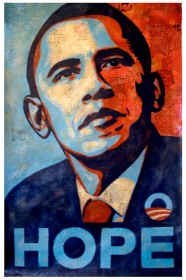
obama_poster_bob_hope

One recent post showed a photo of President Obama tying a bow tie; another discussed the intense fascination with his physical person that seems to have gripped so many people. That led some of us to compare our favorite pictures of Mr O.

The original

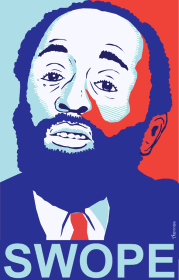
The iconic image of Mr O so far is probably Shepard Fairey‘s “Hope” poster. In October, Fairey himself contacted boingboing.net with a link to a collection of spoofs of his poster. A few I can’t resist copying appear after the jump.

With apologies to Robert Downey, Senior

With apologies to Robert Downey, Senior

Wasn't this his official campaign poster?

Wasn't this his official campaign poster?

Pleasant to look at, and useful as an explanation of the word

Pleasant to look at, and useful as an explanation of the word

For fans of 70s TV

For fans of 70s TV

Mr O

Originally published on Los Thunderlads, 26 January 2009:

Photoshop at its finest

Photoshop at its finest

From a friend of the blog:

I’ve been reflecting on how, in these very early days of the Obama administration, there is such relentless focus upon the person of Barack Obama himself, as if the man constitutes the real locus of substantiality in this situation. Ironically, the case is tending so much to the diametric opposite: Obama is a virtual spectre, a wraith, an empty place-holder. He is, top-to-bottom, configured by the present complex of circumstances facing the country and earth (although world conditions have chillingly small bearing on the highly-inward gaze which is the hallmark of US political perspective) … This complex of circumstances, the range of plausible methods to engage it, and the particular types of public reaction that these methods will inexorably evoke: all of this amounts to an essential structure of near-fatalism: A pine cone will not fall up; water will not freeze at boiling temperature. In the same way, the deep-rooted urge to ogle Das Leader, whatever it’s all about, certainly is linked to a voracious need to place the mask of a human face upon a disconcerting, and highly impersonal, black vortex of historical forces. We believe that, because we can see Obama physically upon the TV screen, therefore we can truly see him. What’s even more frightening than the realization that Das Leader is, at bottom, a social construction, is the uneasy suspicion that that social construction is being – cunningly, indefatigably – moulded and tweaked for public consumption by the mind-nexus of power-wealth. Consider the recent news that a US “remote unit” in a border region of Pakistan has killed twenty-two people. Das Leader has not been in power for one week, and he’s already handed down orders to kill people: no evidence required, no judicial process. Pharaoh has put them to death, for he is Pharaoh. And since they (a) were almost certainly not US citizens, and (b) may have satisfied a definition of “terrorist,” they are in consequence right-less subhumans on both counts. The fact that the sarcastic final clause of my prior sentence would meet with a thoroughly above-board “yeah” of acknowledgment from vast legions of Americans, with no ensuing deeper rumination, is a sobering index of where we are.”

From Acilius’ reply:

“good points about Mr O. one of the reasons i like to call him “Mr O” is that the letter O does suggest the “empty place-holder” 0. he is a vacant space which the spectator can fill with any image s/he may wish. his accession to the presidency invites us to construct in our minds any narrative that may help us to live with “a disconcerting, and highly impersonal, black vortex of historical forces.” (america’s 44th, and first black, vortex of historical forces.) that narrative may concern a redeemer prince who embodies our highest hopes or a leering tyrant who confirms our deepest fears. in either case, we can feel that the processes in which we are enmeshed are familiar, intelligible, human. it isn’t too different from what we were talking about before. those of us who don’t understand theoretical physics can listen to an explanation of the big bang, visualize eggs hatching, and tell ourselves that the familiar image we have thereby produced is the way it really happened. it then seems to us that the physical world isn’t so puzzling after all. if we can understand ordinary eggs, how much harder could it be to make sense of a cosmic egg? the social world might also seem less mystifying if we can reduce its larger scale processes to personal narratives. and not the personal narratives of actual, complex human beings, but the personal narratives of archetypal figures familiar in legends as old as the stone age and as fresh as the movies.”

Let me clarify my remarks here. These remarks are from an email discussion that had, the week before, centered on what goes in the minds of scientific illiterates such as myself when we hear experts try to explain the Big Bang theory. My idea was that as we listen, we tend to draw on the same kind of nature imagery that people have been using since prehistoric times to devise myths that would help make the confusing, dangerous, frustrating aspects of reality seem familiar and comprehensible. So whatever the physicists on the History Channel’s The Universe may be trying to say, what I and people like me end up believing we heard is a Cosmic Egg creation story that could have been told around any Neolithic campfire.

In my reply above, I suggest that the fixation on Mr O may be part of a similar phenomenon. I do not mean to suggest that my correspondent is trying to cast Mr O as a “leering tyrant” and thereby to make his own myth about him. This last point would likely have been clear in the original context, since my correspondent voted for Mr O and has in the past supported other politicians whom no one would regard as incapable of the “Pharaonic” behavior he laments. Nor do I mean to deny that there may be situations in which an individual can take an action that will change the course of history.

Robert Frost and Conrad Aiken

Originally published on Los Thunderlads, 27 December 2008:

Aurora e Titone, by Francesco de Mura

Aurora e Titone, by Francesco de Mura

(image)

In Greek myth, Tithonus was a Trojan prince, the brother of King Priam. According to a poem of the early seventh century BC, the Homeric Hymn to Aphrodite (lines 218-238,) Tithonus’ youthful good looks attracted the attentions of Eos, the goddess of the dawn. Aphrodite had condemned Eos to lust after mortal men. Eos abducted Tithonus and kept him in her mysterious land in the east. She lavished him with gifts. Eos went so far in her generosity to Tithonus as to ask Zeus to make Tithonus immortal. That may have been going too far, or not far enough- Eos neglected to ask Zeus to stop Tithonus’ aging. So he grew old, lost all ability to move his limbs, and took to babbling incessantly. Eos locked him up in a golden chamber when this happened. The hymn’s detail about Tithonus’ babbling may be reflected in later traditions that represent him as a great singer. The fifth-century BC writer Hellanicus of Lesbos says that Eos took pity on him and turned him into a cicada, a creature whom the ancients suspected might be immortal. In the poem below, Aiken follows the modern tradition of representing Tithonus as a grasshopper rather than a cicada.

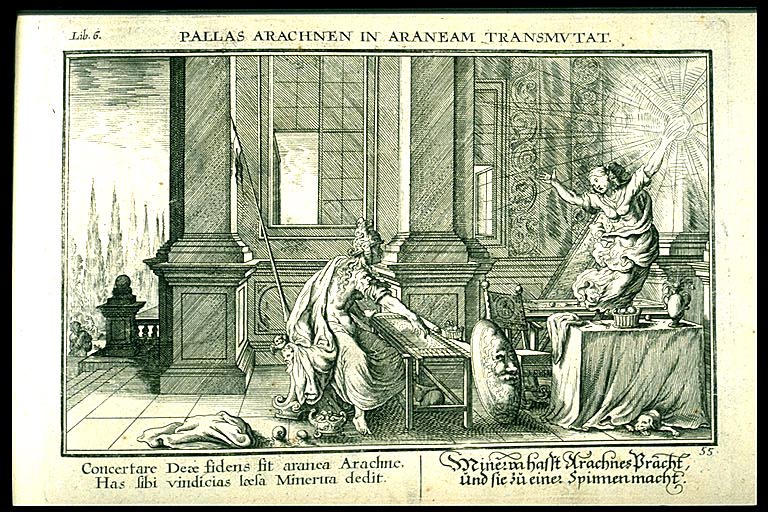
Arachne transformed, from a 1703 edition of the Metamorphoses of Ovid illustrated by Johann Wilhelm Bauer

Arachne transformed, from a 1703 edition of the Metamorphoses of Ovid illustrated by Johann Wilhelm Bauer

(image)

According to Ovid’s Metamorphoses, Arachne was a maiden from Lydia in Asia Minor who challenged the goddess Minerva (the Greeks would have said the goddess was Athena) to a weaving contest. When Arachne won this contest, the goddess responded with such fury that Arachne hanged herself. Taking pity on her victim, Minerva revived the girl in the form of a spider. Ovid represents Arachne as an innocent, though she has been thought of in other ways at other times. The story of Arachne’s encounter with Tithonus appears to be Aiken’s own invention. Aiken also takes some further liberties with the story, as you will see.

The Wedding,” by Conrad Aiken

At noon, Tithonus, withered by his singing,

Climbing the oatstalk with his hairy legs,

Met grey Arachne, poisoned and shrunk down

By her own beauty; pride had shrivelled both.

In the white web- where seven flies hung wrapped-

She heard his footstep; hurried to him; bound him;

Enshrouded him in silk; then poisoned him.

Twice shrieked Tithonus, feebly; then was still.

Arachne loved him. Did he love Arachne?

She watched him with red eyes, venomous sparks,

And the furred claws outspread… “O sweet Tithonus!

Darling! Be kind, and sing that song again!

Shake the bright web again with that deep fiddling!

Are you much poisoned? sleeping? do you dream?

Darling Tithonus!”

And Tithonus, weakly

Moving one hairy shin against the other

Within the silken sack, contrived to fiddle

A little tune, half-hearted: “Shrewd Arachne!

Whom pride in beauty withered to this shape

As pride in singing shrivelled me to mine-

Unwrap me, let me go- and let me limp,

With what poor strength your venom leaves me, down

This oatstalk, and away.”

Arachne, angry,

Stung him again, twirling him with rough paws,

The red eyes keen. “What! You would dare to leave me?

Unkind Tithonus! Sooner I’ll kill you and eat you

Than let you go. But sing that tune again-

So plaintive was it!”

And Tithonus faintly

Moved the poor fiddles, which were growing cold,

And sang: “Arachne, goddess envied of gods,

Beauty’s eclipse eclipsed by angry beauty,

Have pity, do not ask the withered heart

To sing too long for you! My strength goes out,

Too late we meet for love. O be content

With friendship, which the noon sun once may kindle

To give one flash of passion, like a dewdrop,

Before it goes!… Be reasonable, — Arachne!”

Arachne heard the song grow weaker, dwindle

To first a rustle, and then half a rustle,

And at last a tick, so small no ear could hear it

Save hers, a spider’s ear. And her small heart,

(Rusted away, like his, to a pinch of dust,)

Gleamed once, like his, and died. She clasped him tightly

And sunk her fangs in him. Tithonus dead,

She slept awhile, her last sensation gone;

Woke from the nap, forgetting him; and ate him.

Spider eats cicada

Spider eats cicada

(image)

Acceptance,” by Robert Frost

When the spent sun throws up its rays on clouds

And goes down burning into the gulf below,

No voice in nature is heard to cry aloud

At what has happened. Birds, at least, must know

It is the change to darkness in the sky.

Murmuring something quiet in her breast,

One bird begins to close a faded eye;

Or overtaken too far from his nest,

Hurrying low above the grove, some waif

Swoops in just in time to his remembered tree.

At most he thinks or twitters softly, “Safe!

Now let the night be dark for all of me.

Let the night be too dark for me to see

Into the future. Let what will be, be.”

Boxing Day 2008

Originally published on 26 December 2008:

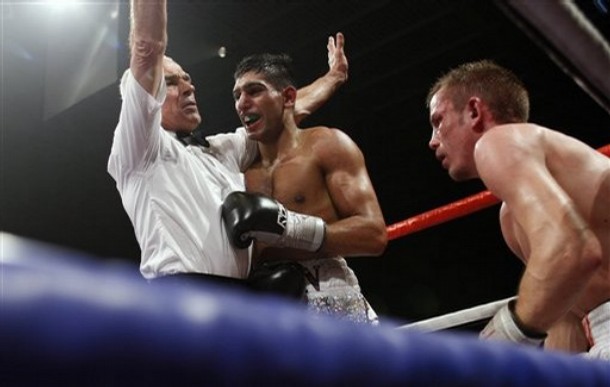
Referee Micky Vann ends a fight between Amir Khan and Martin Kristjansen, 5 April 2008:

Micky Vann
Micky Vann

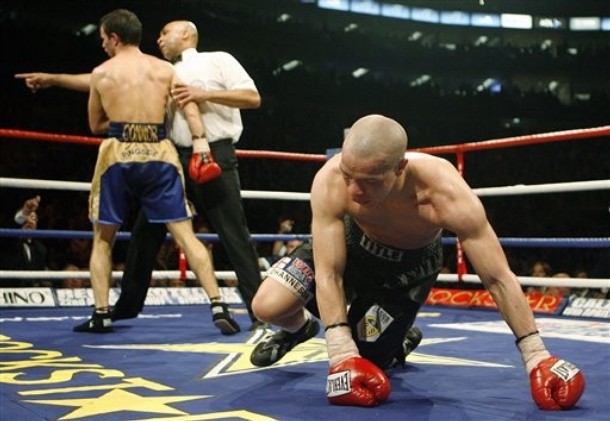
Referee Ian St. John steps in between Kevin Mitchell and Carl Johanneson, 9 March 2008:

Ian St John
Ian St John

Referee Raul Caiz Jr separates Bernard Hopkins and Howard Eastman, 19 Feb 2005:

Raul Caiz, Jr.
Raul Caiz, Jr.

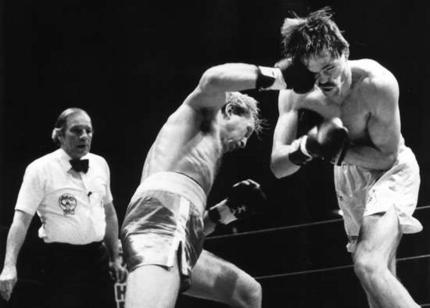
Referee Gus Mercurio watches Barry Michael connect with Lester Ellis, 12 July 1985:

Gus Mercurio

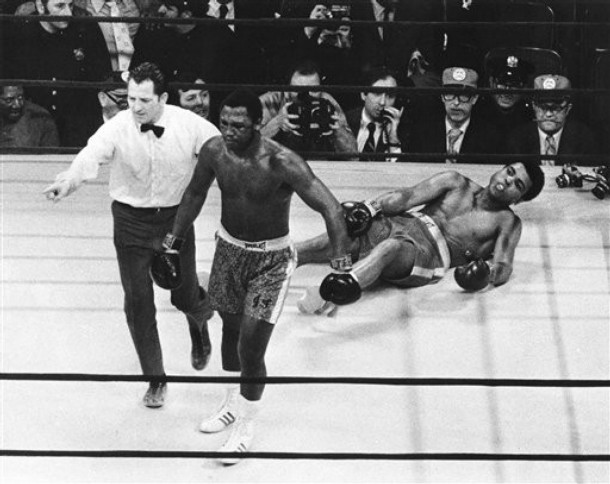
Referee Arthur Marcante takes Joe Frazier to his corner while Muhammad Ali gets up, 8 March 1971:

Arthur Marcante
Arthur Marcante

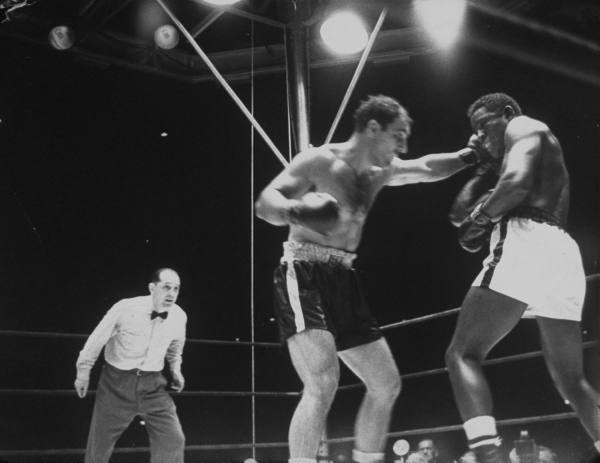
Referee Ruby Goldstein ready for action as Rocky Marciano and Ezzard Charles fight for the heavyweight title, June 1954:

Ruby Goldstein

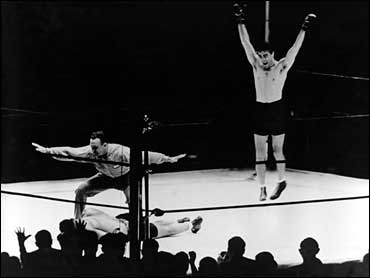
Referee Arthur Donovan declares Joe Louis knocked out and Max Schmeling the new champion, 16 June 1936:

Arthur Donovan
Arthur Donovan

Notes on the 6 Oct 2008 issue of The American Conservative

Originally posted on Los Thunderlads, 24 October 2008:

For me, the highlight of this issue was a piece by Claes G. Ryn, editor of Irving Babbitt in Our Time, The Representative Writings of Irving Babbitt, and the author of Will, Imagination and Reason: Irving Babbitt and the Problem of Reality. Unfortunately Professor Ryn does not mention Babbitt’s name in this article, but he does give a strongly Babbittian analysis of the so-called “conservatism” that has entranced so many of America’s policy makers. After rehearsing Babbitt’s argument that our Constitution can work only in a society where people are committed to simplicity, value tradition, and are accustomed to respecting limits, Ryn discusses the theories of Leo Strauss, whom he considers to be a sort of anti-Babbitt. “According to Strauss,” Ryn writes, “no real philosopher gives credence to ‘the conventional’ or ‘the ancestral,’ to use his terms. Respecting them represents the greatest of all intellectual sins, ‘historicism.’ Inherited ways are, he insisted, mere accidents of history. Respect is owed to the ‘simply right,’ which is ahistorical and rational.” It is this ahistorical, anti-traditional, intellectualistic creed that has inspired neoconservative thinkers who have argued in favor of the wars and other power grabs of the current administration in Washington.

Anna van Riel

Originally published on Los Thunderlads, 18 July 2008:

Ukulele Hunt’s latest video of the day showcases New Zealand’s Anna van Riel playing a nifty little tune of her own composition.

She’s also on youtube as half of the acoustic duo Bellebird; here they play their song “Too Strong Daddy,” apparently in their living room.

http://www.youtube.com/watch?v=fEzCkncyI-Q

Of course she’s on myspace; the videos are registration-only, but there’s music available on the home page.

http://www.myspace.com/annavanriel

And the band’s myspace page has several free songs.

http://www.myspace.com/bellebirds

http://ukulelehunt.com/