Tuesday, September 13, 2011

Scientists need media advisors

Originally published by Acilius on Los Thunderlads, 12 September 2011. Go to that post for comments.

The other day I read an article in Popular Science magazine profiling Felisa Wolfe-Simon, the NASA-sponsored scientist who made headlines in December with a paper claiming that a particular strain of bacteria throve in environments high in arsenic and low on phosphorous. Wolfe-Simon hopes to find a life form that uses arsenic in its DNA in the way that all other known organisms use phosphorous, and NASA foregrounded that hope in its publicity for the paper. While Wolfe-Simon did not claim that she had proven that the bacteria were using arsenic in this way, so much press discussion centered on that idea that when subsequent findings suggested that they probably weren’t, she was subjected to a kind of disgrace. In the Popular Science piece, Wolfe-Simon says that her career may very well be over now.

After I’d read this sad tale, I turned on the TV. The History Channel was showing a program they’d produced in 2008 about Professor Bruce Bueno de Mesquita, a political scientist who has used game theory to devise an algorithm for use in analyzing high-level decision-making. To be precise, about a third of the show concerned Professor Bueno de Mesquita. This third included many excerpts of the professor and his associates talking to the camera about his research. The other two thirds were about Nostradamus. Neither Professor Bueno de Mesquita nor any of his associates ever mentions Nostradamus, and only one of the many Nostradamus fans who appear mentions Professor Bueno de Mesquita. I strongly suspect that the professor did not know that he was going to be presented as “The Next Nostradamus.”

Monday, September 12, 2011

Two opinion surveys I have not conducted

Originally published on Los Thunderlads, 12 September 2011:

1. I teach in a state university deep in the interior of the USA. It is likely that most of my students plan to settle in urban areas after they graduate, but a significant minority would strongly prefer to live in rural areas. And it is definitely the case that most of them are looking for a person with whom to live, in whichever setting they prefer.

The students seem to spend more time than one might expect arguing about what restrictions, if any, the law should place on private gun ownership. I wonder if they raise this topic as a way of signaling to potential mates whether they plan to settle in the city or in the countryside. I’m not an opinion researcher, but perhaps someone who is might like to see if support for lax gun laws is a strong indicator of a preference for a rural life and support for restrictive gun laws is a strong indicator of a preference for city life. If it should turn out that these opinions are strong indicators of these preferences, it would be interesting to see under just what sort of circumstances people volunteer opinions about gun control and strive to be identified with those opinions.

2. My wife has cerebral palsy. Many of her friends, like her, grew up with major disabilities. The university where I teach prides itself on accessibility to the disabled, so both through my marriage and through my work I have come to know a substantial number of articulate, highly educated people who have been visibly disabled throughout their lives.

It seems to me that the people I know who meet this description show the same range of opinions as do Americans generally about public policy regarding abortion. Some think that abortion should always be legal, some think it should always be illegal, some support each of a variety of restrictions. What none of them accepts is the label “pro-choice.” I’ve heard people who would not vote for a policy that would bar or discourage any abortion anywhere hotly deny that they are “pro-choice.” I don’t know if my acquaintances are in any way representative of Americans with disabilities. If a survey showed that American adults who grew up as disabled children are in fact much more likely to want to keep abortion legal than they are to call themselves “pro-choice,” and that they are in this way different from American adults who grew up without visible disabilities, I wonder what we might find about the label “pro-choice” and the rhetoric associated with it that they find repellent.

The Nation, 26 September 2011

Originally published on Los Thunderlads, 9 September 2011:

James Longenbach contributes a surprisingly sympathetic review of a collection of letters by the young T. S. Eliot. Longenbach argues that Eliot’s Unitarian family made a fetish of doubt and complexity, and that the aspects of Eliot’s life and thought that puzzled them came from a rebellion against this fetish, against “the Eliot Way.” Eliot rebelled against what he called “the Way of Doubt” by time and again taking actions that entailed an irrevocable commitment. As Longenbach puts it:

In retrospect, all of the momentous events in Eliot’s life were determined by a moment of awful daring. In 1933 he left Vivien as abruptly as he had married her, and his decisions to enter the Church of England and, many years later, to marry his secretary, Valerie Fletcher, were similarly nurtured in complete secrecy and subsequently revealed to a world in which even close friends were baffled by Eliot’s behavior, left feeling as if they had never known him. To Eliot’s Unitarian family, a conversion to Anglo-Catholicism seemed as explicable as an initiation into a cult.

Considering this disposition of Eliot’s, and in view of his time and place, it is nothing short of amazing that he did not join the Blackshirts. When Longenbach provides this excerpt from an unpublished essay of Eliot’s, it becomes amazing that he didn’t murder anyone:

In Gopsum Street a man murders his mistress. The important fact is that for the man the act is eternal, and that for the brief space he has to live, he is already dead. He is already in a different world from ours. He has crossed the frontier. The important fact that something is done which cannot be undone—a possibility which none of us realize until we face it ourselves. For the man’s neighbors the important fact is what the man killed her with? And at precisely what time? And who found the body?… But the medieval world, insisting on the eternity of punishment, expressed something nearer the truth.

The man’s neighbors, in their fascination with the details of the crime, might easily fall into a psychological or other scientific explanation of the killer’s motivation, which would in turn reduce the crime itself to the ordinary level of everyday life. The medieval view insists that murder, like other sin, is not ordinary, that it is a thing set apart from the created world around us. Eliot may not have craved murder, but he did crave that sort of setting apart. For him, it was a lie to say that the whole world is one thing and that it can be reduced to one set of laws. Eliot’s onetime teacher Irving Babbitt was fond of quoting Ralph Waldo Emerson’s lines, “There are two laws discrete,/ not reconciled–/ Law for man and law for thing;/ The last builds town and fleet,/ But it runs wild,/ And doth the man unking… Let man serve law for man,/ Live for friendship, live for love,/ For truth’s and harmony’s behoof;/ The state may follow how it can,/ As Olympus follows Jove.” These lines come from a poem Emerson dedicated to W. H. Channing. W. H. Channing was the nephew of Unitarian theologian William Ellery Channing, and like Emerson was himself a Unitarian preacher. The Channings, Eliots, and Emersons were all related to each other, so Eliot likely perked up when he heard Babbitt quote these lines.

While Emerson may have concluded that the “Law for Man” is best observed by general friendliness, Babbitt drew a more sobering conclusion. In his first book, Literature and the American College (which takes the lines from Emerson as its epigraph,) Babbitt explained that he called himself a “humanist” rather than a “humanitarian” because the former word suggests a more selective sympathy than does the latter. One can see the humanitarian impulse, in Babbitt’s sense of the word, in the neighbors’ insistent focus on the practical details of the murder, in the implication that the act of murder can be reduced to those details, that it can therefore be put on a level with other acts a person might perform. The humanitarian impulse thus reduces even murder to one form of behavior among many. In an age dominated by humanitarianism, murder loses its terror. The word “mystery” comes to mean, not that of which one may not speak because it lies outside the ordinary realm of our experience, but that of which one must inquire until it can be reduced to the ordinary realm of our experience. The “murder mystery,” a story in which investigation reveals that a murder was of a piece with the ordinary life around it, thus emerges as the signature genre of the humanitarian age.

Longenbach doesn’t mention Babbitt, through the study of whom I first became seriously interested in Eliot. Nor does he mention Eliot’s Royalist politics, one of the aspects of Eliot’s thought that kept Babbitt from taking his former student seriously. However, I was thinking of Eliot the Royalist earlier today, when I offered a comment on the website Secular Right. A post there complained about a speech Prince Charles had made about global warming. As rightists, the authors of the site aren’t much interested in speeches about global warming; as secularists, when they hear such a speech from the heir apparent to a throne which sits at the center of the established Church of England, they are quick to attribute it to a yearning for the apocalyptic. For good measure, the post threw in an identification of the prince as an “aristocratic idler.” I suggested in reply that this yearning might be a sign that the House of Windsor is an unsatisfactory sort of monarchy:

It might be better if Prince Charles truly were an “aristocratic idler.” As it is, his handlers set myriad tasks for him each day, among them the delivery of public statements that reassure various groups that their concerns are being taken seriously at the highest levels of the state. This frees the people who actually exercise power at the highest levels of the state to ignore those concerns. If the prince and his immediate family were relieved of this chore and their other public functions, they would have an opportunity to withdraw into seclusion, appearing only on those occasions when they might strike awe into the natives. Then the UK might have a proper monarchy, distant, godlike, surrounded by an aura of high majesty and cold terror. Then there would be no need for the heir apparent to repeat warnings about the end of the world; the sound of his name would suffice to fill the people who find such warnings emotionally satisfying with the dread they crave. Failing that, you might as well have a republic.

Walter Bagehot said that there can be arguments for having a splendid court and arguments for having no court, but that there can be no arguments for having a shabby court. I’d say that there can be arguments for having a terrifying king and arguments for having no king, but that there can be no arguments for having an unrelentingly ordinary sort of person as king.

I call Charles “an unrelentingly ordinary sort of person,” not only because his statement is a pack of cliches, but also because of his busy-ness and because he is so familiar a figure. Irving Babbitt criticized the cult of busy-ness in his own time as something that robbed life of depth; today, the same cult has gone to such extremes that it has reduced people to interchangeability. By the end of the day, virtually anyone who had completed Prince Charles’ schedule would be indistinguishable from Prince Charles. And his constant presence in the public eye makes it impossible to accept the prince as a figure embodying any kind of mystique. As humanitarianism has made murder an ordinary act, albeit a costly one, and murderers ordinary folk, so too it has made kingship an ordinary job and kings ordinary fellows. I don’t disagree with the Secular Right crowd that there is an unwholesome yearning for the apocalyptic afoot in our time; though perhaps that yearning is in fact simply a yearning for an event that will cast ordinariness aside once and for all.

Babbitt also came to my mind when I read a post on the Nation‘s blog, “The Notion,” about the end of the Jerry Lewis Telethon. I should explain that every year since the early 1960s, comedian Jerry Lewis has occupied a bloc of several hours of television time, ending on the morning of the first Monday in September (Labor Day in the USA.) During that time, a variety of entertainment acts would perform; in between acts, Lewis and others would solicit funds for the Muscular Dystrophy Association. Lewis made his name as a comedian by mocking people with spastic conditions, so one would think that he was doing penance by raising money for research into Muscular Dystrophy, though he never seems to have made the connection. What he did do was present people with Muscular Dystrophy as helpless objects of pity; the archetypal moment of the telethon came in 1973 when he held up a child with Muscular Dystrophy and said “God goofed, it’s up to us to correct his mistakes.” Not everyone with Muscular Dystrophy was happy to be declared one of God’s mistakes, nor did all of them enjoy wearing the label “Jerry’s Kids.” For more than 20 years, the pitying, patronizing tone of the telethon has inspired people with Muscular Dystrophy to protest outside the theater and around the country. While the Muscular Dystrophy Association, funded largely by the telethon, does a great deal of good, many of its best programs have taken their direction from people who object most strongly to Lewis and his maudlin display. The post expresses relief that the telethon is finally ending.

Again, I would say that what made the telethon so hard to take was its denial of mystery, of mystery in the sense of a realm apart from the ordinary. People with Muscular Dystrophy suffer and die, and in their physical aspects those experiences are a brutally ordinary affair of deterioration and destruction. But when people show respect to each other, they agree to look at each other not only in terms of the biological processes that are inexorably carrying all of them to death and decomposition, but also in terms of the stories they tell about themselves, of the roles they play in the groups that matter to them, and of the effects they hope to have on the world. The idea of a “law for man,” of a realm apart from the ordinary processes of matter and energy, can give such stories and roles and hopes an urgency that the worldview which Babbitt would call humanitarian cannot. That isn’t to say that every materialist is doomed to be as big a jerk as Jerry Lewis, or that every dualist will as a matter of course keep a humane perspective when meeting someone who has a visible disability, of course. But it may help to explain why Lewis and his apologists were sincerely unable to understand what he was doing wrong.

Babbitt cared enormously about Socrates, often listing him alongside the Buddha and Jesus as the three greatest men who ever lived. So if this issue of The Nation were to have fallen into his hands, Babbitt would likely have turned directly to Emily Wilson’s review of Bettany Hughes’ The Hemlock Cup: Socrates, Athens, and the Search for the Good Life. Bettany Hughes has become a bit of an industry; an Oxford-trained classicist, she has presented many television popularizations of classical scholarship and written books tied in with them. Partly this may be a consequence of her marriage to television producer Adrian Evans, partly to her looks (YouTube’s suggestion, when you begin typing in “Bettany Hughes,” is “Bettany Hughes hot.”) Still, I don’t doubt that Michael Grant and Rex Warner and Gilbert Murray and Edith Hamilton and Erasmus and all the other popularizers of the classical tradition over the years had their own ways of gaining position, and I’ve found some of her videos useful. So I don’t begrudge her the fame and fortune she has reaped.

Wilson is bemused by the Bettany Hughes industry. And she has some harsh words for this book:

The Hemlock Cup is not a biography of Socrates. Nor is it a book for a specialist, or one that any reader, specialist or not, will want to take slowly. Hughes has nothing to say about Socrates that is not pure cliché: Socrates was “a maverick,” “individual to his core,” “very human,” somebody with a “radical” and “refreshing” “take on the issues of life,” and who “decided to pursue not just the what, but the why.” In general the prose limps along from dangling modifiers to dramatic, verbless sentences to one-sentence paragraphs. Socrates, inspired by his daimonion, was “Rapt. Lost in his own mind.” Vivid. Also annoying. The first sentence of the introduction—“We think the way we do because Socrates thought the way he did”—is, as it stands, clearly false, though you can roughly understand its meaning. There are lots of sentences like that, which one can easily imagine Socrates himself, on a mean day, tearing to shreds.

Readers of Plato may be surprised to learn from Hughes that “Socrates did not believe in or deal with abstracts.” In dialogues such as Laches, Lysis and Euthyphro, Socrates is ostensibly concerned with nothing but the attempt to define the “abstracts” of courage, friendship and holiness. This Socrates may not be a historical character, but Hughes gives no indication of whether, or why or how, she mistrusts Plato as a source. Her use of textual evidence is also sketchy. No sources are given for the injunction “Understand yourself by loving those around you”; one might well doubt that either the historical or the Platonic Socrates held any such belief. Readers may puzzle over what it means to say that “Socrates believed humanity was society”—unless it’s just a rhetorical way of saying that Socrates, like everybody else, knew that people are social. Surely it doesn’t take the wisest man in the world to figure that out.

Treating an academic book, Wilson might stop there. However, she realizes that Hughes is aiming to introduce Socrates to a general audience, and so praises Hughes’ “television-presenter’s eye for visual detail” that may not offer much to a professor of Greek, but that does make the Athens of Socrates seem more real to a reader with no special background in the subject.

Babbitt’s best friend was Paul Elmer More, who edited The Nation from 1909 to 1914. After his retirement from journalism, More devoted himself to literary criticism and the history of philosophy. More coined the phrase “the Inner Check” based on his conversations with Babbitt and his reading of Plato’s Apology. This phrase expresses an idea which many have regarded as the central metaphysical proposition of the school associated with Babbitt and More. The idea is that the ancients, including Socrates, the Buddha, and most other sages of pre-Christian Europe and Asia, believed in free will, but that they believed that will to be solely a capacity for negation. Babbitt, responding to Henri Bergson’s philosophy of the élan vital, preferred the term frein vital to More’s “Inner Check,” but meant the same thing by it. Since so many wise men in such a wide variety of societies had arrived at this conclusion, Babbitt and More reasoned, it would be unreasonable to reject it.

So, it should be clear what Babbitt and More would have thought of a scholar who interpreted Socrates’ message as “Understand yourself by loving those around you,” and even clearer what they would have thought of one who said that the daimonion, which as More pointed out is Socrates’ term for the sensation that he ought not to do a particular thing, would lead him to be “lost in his own mind.” On the contrary, More argued that it was precisely this sensation that kept Socrates focused when others around him were losing their way in the confusions of his time.

Tuesday, September 6, 2011

New post on Los Thunderlads

The site you are now reading consists almost entirely of reposts from the blog where I do most of my posting, Los Thunderlads. I maintain this site as a backup in case something happens to that one. Occasionally people leave comments here; I feel sorry for them, since I am the only person who is at all likely to read those comments, and even I sometimes go for weeks on end without looking at them. On the other hand, comments posted on Los Thunderlads will usually get looks from a few people, so today, I put up a post there giving exposure to some of these comments.

Monday, September 5, 2011

Chronicles, December 2010

Originally published on Los Thunderlads:

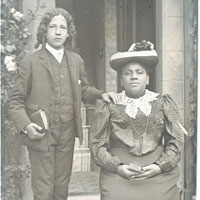
Lawrence Dennis and his foster mother circa 1908, when he toured England as "the boy evangelist"

I never quite finished my notes on the December 2010 issue of far-right Chronicles magazine, but it includes several notable pieces. So I’ll mention them now, months late though I may be.

Justin Raimondo brings up one of his favorite writers, Lawrence Dennis. Dennis is also one of my favorites, though I think it is rather stretching matters for Raimondo to call Dennis an “African-American intellectual.” Certainly Dennis’ background was African-American; when the 12 year old Dennis toured England as “the boy evangelist” in 1908, his ethnicity gave him an exotic appeal. And he was undoubtedly an intellectual. When he was on trial for sedition in 1944, government witness Hermann Rauschning startled the prosecutor by testifying that Dennis was not a tool of the Nazis, but was a thinker fit to be compared with Oswald Spengler. Dennis was conducting his own defense; when time came for him to cross-examine Rauschning, he rose and thanked him. Yet Dennis was hardly the spokesman for the African American experience that we’ve come to expect when we hear the phrase “African American intellectual.” He said little about the African American experience, and never presented himself as a representative of African Americans. Indeed, the only book-length study of Dennis is titled The Color of Fascism: Lawrence Dennis, Racial Passing, and the Rise of Right Wing Extremism in the United States, and interprets Dennis’ writings and political behavior as symptoms of a life spent passing for white. As Robert Nedelkoff put it in a sympathetic piece about Dennis that he contributed to issue #13 of The Baffler (published in October 1999,) “when he spoke of race relations he made no reference to his being of a particular race” (page 99.) Nedelkoff’s piece, covering pages 93-100 in that issue of The Baffler, was the second place I’d read of Dennis; the first was the chapter on Dennis in Ronald Radosh’s 1975 book Prophets on the Right. Between them, these pieces convinced me that Dennis was more interesting than his onetime embrace of the label “fascist” would indicate. In a series of books published between 1933 and 1941, Dennis predicted that the USA would eventually adopt an economic system similar to those prevailing in Italy and Germany at that time; that this new system would be promoted as a triumph of America’s traditional system; and that he himself would be prosecuted for sedition for saying that free speech was obsolete. Looking back in his final book, Operational Thinking for Survival (1969,) Dennis concluded that all of his predictions had been vindicated.

Chilton Williamson shares fond memories of the time when he and the late Joseph Sobran worked together at National Review. I always looked forward to Sobran’s columns because of the witty remarks that so often appeared there, though I can’t say I ever found a well-constructed argument in any of them. I must mention a grievance I have against Sobran. One of the statements he made that got him fired from National Review and driven to the fringes of society was praise for the magazine Instauration. Because I found much to admire in Sobran’s work, I looked for Instauration. When the magazine became available online, I read several issues. I’d expected an intellectual magazine marked by a hard-headed conservatism, with some pieces that crossed the line into racial prejudice. In other words, I was braced for something rather like Chronicles, only more extreme. Imagine my disappointment when instead I found a racist tract containing article after article dismissing the Holocaust as a hoax (in the first issue the editors express great satisfaction in putting the word “Holohoax” into print.)

George McCartney reviews the movie The Social Network, by Aaron Sorkin. Sorkin’s grand project seems to be showing groups of aggressive, self-indulgent people clashing with each other in the course of work that creates a benign product. The difficulty with such works as The Social Network and The West Wing is that the real-life counterparts of Sorkin’s characters seem to be far more quietly efficient and their products far more problematic than he allows. So Mark Zuckerberg is rumored to be rather a pleasant sort of chap; Facebook has unnerving features that lead me to call its administrators “the Zuckforce.” Actual staffers in the White House probably spend less time dashing about the corridors and snarling at each other than they do showing friendliness and good manners; but the US presidency, as they help to constitute it, may well be the single most destructive institution in the world today. Someone like Lawrence Dennis, were he to see a society with a surveillance network like Facebook and a political leader who starts a war every year or two, would likely show little interest in whether the people administering that network and staffing that leader observed the social graces. In the popularity of Facebook, he might see a people who had become so thoroughly inured to surveillance that they can enjoy themselves only in an environment structured to record their every move; in The West Wing, a people so inured to war that they expect to enjoy a cozy relationship with the chief warlord.

Saturday, September 3, 2011

"Great Universities" and "Great Cities"

Originally published on Los Thunderlads, 25 March 2011:

The other day, I made a long comment on a post at the blog commonly known as “Gelman.” The original post is by the blog’s namesake, Professor Andrew Gelman. Gelman referred to a newspaper piece by Professor Edward Glaeser on the idea of developing an applied sciences center in New York City. Glaeser makes some rather strong claims for the power of universities to promote economic development in the cities to which they are attached. Blogger Joseph Delaney had put something up in which he expressed doubts about Glaeser’s general claims, challenging those who would defend them to explain why New Haven, Connecticut, home of Yale University, is such a dump.

Gelman is impressed by Delaney’s post. He also picks up on a paragraph in Glaeser’s piece that includes a quote from New York’s late US Senator Daniel Patrick Moynihan:

The late Senator Daniel Patrick Moynihan of New York is often credited with saying that the way to create a great city is to “create a great university and wait 200 years,” and the body of evidence on the role that universities play in generating urban growth continues to grow.

Gelman doesn’t dwell on Moynihan’s words; he makes it clear in the comments (here and here) that what really interests him is the question of the economic impact of universities on their urban environments in the (moderately) long run. Many other commenters (for example, this person) expressed doubt as to whether any answer to the question could be tested quantitatively, considering how few “great universities” and “great cities” there are at any point in time. In my comment, I suggest that if we take Moynihan’s words literally (admittedly, a rather silly thing to do) we might be able to develop a quantitative test of his hypothesis:

Well, if we take Moynihan’s claim literally, what we need are two lists: a list of “the great universities” as of year n, and a list of “the great cities” as of year n + 200. Of course we wouldn’t want to top-of-the-head either of those lists, so as to avoid some kind of Clever Hans effect.

I haven’t looked for any list that anyone has put forward of “the great universities” as of any particular year, but it sounds like the sort of thing many historians would be fond of producing. And lots of people like to make lists of “the great cities.” Once we have a list, however subjectively it was generated, we can look over the items, try to find quantifiable characteristics that most or all items on it share, and having found such characteristics we can refine the list by adding other items that share them or deleting items that don’t share them. So we can try to work backward to foundations.

As for Yale, I doubt very much that you could find any reasonable criterion by which it either was or had been a “great university” in 1811. Nowadays, sure, but in its first centuries it was a backwater. Would any American university have qualified as “great” in 1811? The faculty of the College of New Jersey, later renamed Princeton University, had been home to quite a few distinguished scholars from Edinburgh in the late eighteenth century, and Columbia had produced a lot of impressive alumni by 1811. Still, it would seem a bit much to call either of them a “great university” at that early date.

Other commenters, such as universally beloved public figure Steve Sailer, have brought up the idea that it isn’t great universities that make the cities attached to them great, but great cities that make the universities attached to them great. Here again, I’d ask to see two lists: the world’s “great cities” as of year n, and the world’s “great universities” as of year n + whatever number you like. New Haven continues to be a counterexample; while Yale may never have been on any list of the world’s “great universities” until the middle of the twentieth century, it undeniably has a place on any such list today. Yet New Haven has never been anyone’s idea of a “great city.” How many seats of the “great universities” have been?

Of course, one challenge in analyzing such lists would be deciding which universities are attached to which cities. It may not be controversial to say that Cambridge, Massachusetts is part of Boston, and so to give Harvard as an example of a (currently) great university located in (what I’d call) a great city; but what about San Francisco and the two great universities in the Bay Area? Is Berkeley really part of San Francisco? You go through Oakland to get from one to the other, and Oakland is most definitely not part of San Francisco. Is Palo Alto part of San Francisco? The relationship between Stanford University and San Francisco is often cited as one of the things that makes that city great, but Palo Alto is in fact 35 miles from San Francisco at their closest points, and Stanford’s campus is further than that. San Jose, a very different city, is only half as far, and it’s southward to and beyond San Jose that Stanford-based tech entrepreneurs have usually gone.


When is it ethical to accept a prize?

Originally published on Los Thunderlads, 7 April 2011:

In a post here a few months ago, I described some views expressed by my namesake, Roman historian Gaius Acilius. Acilius, who was in his prime in the year 155 BC, apparently had some concerns about the conditions under which it was appropriate to accept praise. In particular, Acilius seems to have wondered if it could be right to accept praise offered on a particular basis if one were not prepared to accept blame offered on that same basis.

I was reminded of this a few moments ago, reading the news. Martin Rees, Britain’s Astronomer Royal, has accepted the Templeton Prize. This exchange from an interview Rees gave to Ian Sample of The Guardian made me wonder what Acilius would have said:

IS: What do you think the Templeton prize achieves? What is the value of it?

MR: That’s not for me to say to be honest.

IS: You must have a view?

MR: No.

IS: But you think it achieves something?

MR: Well, I mean as much as other prizes, certainly, but I wouldn’t want to be more specific than that.

IS: That’s a shame. Might you at some time in the future?

MR: They are very nice people who are doing things which are within their agenda, but their agenda is really very broad. I should say that I was reassured by the rather good piece in Nature a few weeks ago, which talked about the Foundation and I found that reassuring. Certainly Cambridge University, I know, has received grants from Templeton for editing Darwin’s correspondence, which is a big Cambridge project, and also for some mathematical conferences. They support a range of purely scientific issues.

Imagine if the judges who grant the Templeton Prize had sent Rees a letter, not offering to give him £1,000,000 and add his name to a list of distinguished thinkers as a reward for his achievements, but demanding that he pay them £1,000,000 and allow his name to be added to a list of ill-doers as a punishment for his delinquencies. Would he accept that demand so blithely?