Friday, February 10, 2012

The Rodney King Era

Originally posted on Los Thunderlads, 10 February 2012. Comment there:

[youtube=http://www.youtube.com/watch?v=tgiR04ey7-M]The February 2012 issue of The American Conservative includes several pieces that reflect, directly or indirectly, on the presidential campaign currently underway in the USA, and a couple that have a broader interest.

The American Conservative started in 2002 as a forum for right-wingers who did not want the US to invade Iraq. It continues to give voice to conservative anti-militarism. Several items in this issue further develop right-wing arguments against warfare, among them: Doug Bandow's "Attack of the Pork Hawks" (subtitle: "Loving the Pentagon turns conservatives into big-spending liberals"); William S. Lind's "Clearing the Air Force," which argues that the only useful functions of the United States Air Force are those that support operations led by the Army and Navy, and therefore that those functions should be transferred to those services while the independent Air Force is dissolved; and Kelly Beaucar Vlahos' "Gitmo's Prying Eyes," about the Defense Department's attempt to erase attorney-client privilege for the "unlawful combatants" it holds at Guantánamo Bay and elsewhere. Noah Millman's review of Gershom Gorenberg's The Unmaking of Israel identifies Mr Gorenberg not by his usual sobriquet of "left-wing Zionist," but as a "Jewish nationalist" who accepts a deeply conservative conception of nationhood as the maturity of a people, and who opposes Israeli occupation of the Palestinian territories because that occupation reduces Israel from achieved nation-state to insurgent revolutionary movement.

The cover story, Scott McConnell's "Ron Paul and his Enemies," notes that Dr Paul's campaign has inspired levels of alarm and anger from various elite groups in official Washington far out of proportion to the modest levels of support the good doctor has attracted. Mr McConnell's explanation of this is that those bêtes-noires of The American Conservative, the "neocons," fear that Dr Paul will trigger a movement that will threaten the prestige they enjoy in policy-making circles in the American government. The neocons are the neo-conservatives, adherents of an intellectual movement that traces its origins to the anti-Stalinist Left of the 1930s and 1940s and its rise to political salience in the work of a group of activists, academics, and functionaries who attached themselves to the Senator Henry M. Jackson in the 1960s and 1970s. Like the late Senator Jackson, the neo-conservatives are generally sanguine about the ability of the US government to do good by means of large scale programs intervening in the domestic affairs of both of the United States itself and of other countries. The group around The American Conservative consists of old-fashioned conservatives and libertarians who are deeply skeptical of Washington's potential as a doer of good in any sphere. Mr McConnell's argument, summed up in his piece's subtitle-- "An effective antiwar candidate is what the neocons fear most"-- is that, even though neoconservatives now hold such a stranglehold on respectability in foreign policy discussions in official Washington that the manifest failure of their signature project, the invasion and occupation of Iraq, could not weaken it, they know that it is in fact very tenuous. The mobilization of a powerful antiwar constituency within the Republican Party could send the neocons to the sidelines very quickly, he believes. Therefore, they must move quickly to silence Dr Paul, lest the 29% of Republicans who tell pollsters that they share his antiwar views should crystallize into a force that could shift the national discussion away from the presuppositions of militarism.

One stick with which neoconservative spokesmen and others have beaten Dr Paul is a series of racially charged columns that appeared in newsletters he edited in the early 1990s. Mr McConnell discusses the controversy over these columns thus:

Here the reprise of the story of the newsletters published under Ron Paul’s name 20 years ago proved critical. The New Republic had made a national story of them early in the 2008 campaign. James Kirchick reported that numerous issues of the “Ron Paul Political Report” and the “Ron Paul Survival Report” contained passages that could be fairly characterized as race-baiting or paranoid conspiracy-mongering. (Few in Texas had cared very much when one of Paul’s congressional opponents tried to make an issue of the newsletters in 1996.). With Paul rising in the polls, the Weekly Standard essentially republished Kirchick’s 2008 piece.

I’ve seen no serious challenge to the reporting done four years ago by David Weigel and Julian Sanchez for Reason: the newsletters were the project of the late Murray Rothbard and Paul’s longtime aide Lew Rockwell, who has denied authorship.* Rothbard, who died in 1995, was a brilliant libertarian author and activist, William F. Buckley’s tutor for the economics passages of Up From Liberalism, and a man who pursued a lifelong mission to spread libertarian ideas beyond a quirky quadrant of the intelligentsia. He had led libertarian overtures to the New Left in the 1960s. In 1990, he argued for outreach to the redneck right, and the Ron Paul newsletters became the chosen vehicle. For his part, Rockwell has moved on from this kind of thing.

Intellectual honesty requires acknowledging that much of the racism in the newsletters would have appeared less over the top in mainstream conservative circles at the time than it does now. No one at the New York Post editorial page (where I worked) would have been offended by the newsletters’ use of welfare stereotypes to mock the Los Angeles rioters, or by their taking note that a gang of black teenagers were sticking white women with needles or pins in the streets of Manhattan. (Contrary to the fears of the time, the pins used in these assaults were not HIV-infected.) But racial tensions and fissures in the early 1990s were far more raw than today. The Rockwell-Rothbard team were, in effect, trying to play Lee Atwater for the libertarians. A generation later, their efforts look pretty ugly.

The resurfacing of the newsletter story in December froze Paul’s upward movement in the polls. For the critical week before the Iowa caucuses, no Ron Paul national TV interview was complete without newsletter questions, deemed more important than the candidate’s opposition to indefinite detention, the Fed, or a new war in Iran. On stage in the New Hampshire debate, Paul forcefully disavowed writing the newsletters or agreeing with their sentiments, as he had on dozens of prior occasions, and changed the subject to a spirited denunciation of the drug laws for their implicit racism. This of course did not explain the newsletters, but the response rang true on an emotional level, if only because no one who had observed Ron Paul in public life over the past 15 years could perceive him as any kind of racist.

If the Weekly Standard editors hoped the flap would stir an anti-Paul storm in the black community, they were sorely disappointed. In one telling Bloggingheads.tv dialogue, two important black intellectuals, Glenn Loury and John McWhorter, showed far more interest in Paul’s foreign-policy ideas, and the attempts to stamp them out, than they did in the old documents. Atlantic blogger Ta-Nehisi Coates likened Paul to Louis Farrakhan. He didn’t mean it as a compliment, but the portrait fell well short of total scorn. It was difficult to ignore that the main promoters of the newsletters story, The New Republic and the Weekly Standard, had historically devoted exponentially more energy to promoting neoconservative policies in the Middle East than they had to chastising politicians for racism.

In 2008, Mr McConnell, then The American Conservative's editor, had responded to Mr Kirchick's original piece with stern reproof for Dr Paul. The magazine then endorsed Dr Paul for president anyway, though Mr McConnell himself would later express his preference for Barack Obama. In the paragraphs above, Mr McConnell seems to be rather straining to downplay the newsletter matter. For one thing, while Glenn Loury and John McWhorter are by anyone's standards "important black intellectuals," each of them is rather conservative and neither of them could be accused of having a low tolerance for white-guy B.S.- rather the opposite, in fact. It is true that the early 1990s were a time of unusually raw tension between whites and African Americans; indeed, the late 1980s and early 1990s were an extremely strange period in American history, as Dr Paul's 1988 appearance on The Morton Downey, Jr Show should suffice to demonstrate. But this does not excuse Dr Paul's pandering to the racialist right in those years. Rather, it makes it all the more culpable. In 1991, many parts of the USA, from Crown Heights in New York City to South Central Los Angeles, were teetering on the brink of race riots. In that year, a majority of white voters in Louisiana pulled the lever in support of the gubernatorial campaign of Neo-Nazi David Duke. To peddle racially charged rhetoric at that time was, if anything, more irresponsible, because more dangerous, than it would be today.

An editorial in the same issue discusses Dr Paul from a slightly different perspective. In a single page, it dismisses the newsletters twice, once as "artifacts of a time- the Andrew Dice Clay era in American politics, when the populist right reacted to political correctness-- then a new phenomenon-- by sinning in the opposite direction"; then with this line: "The Rodney King era is a distant memory; the wars and economic outrages of our bipartisan establishment are still very much with us." If these dismissals leave you unsatisfied, there is still a refuge for you on The American Conservative's webpage, where blogger Rod Dreher has repeatedly expressed his objections to Dr Paul's newsletters in very strong terms (see here for one of the strongest of these objections.)

No discussion of "the Rodney King era" would be complete without a reference to The Bell Curve, in which psychologist Richard Herrnstein and historian Charles Murray argued that American society was becoming more stratified by cognitive ability, that cognitive ability is largely inherited, and therefore that America's class system will likely become more unequal and less fluid as the highly intelligent pull ever further away from the rest of us. Four chapters of the book dealt with race, analyzing the average IQ scores of various ethnic groups and concluding that African Americans as a group are likely to be among the hardest hit by the adverse consequences of this trend. Professor Herrnstein and Mr Murray offered chillingly few suggestions as to how this grim scenario could be prevented or ameliorated; Mr Murray's right-of-center libertarianism led him always to emphasize out the ways in which social programs intended to broaden opportunity sometimes redound to the disadvantage of their intended beneficiaries, an emphasis which, in conjunction with the book's overall argument, seemed to suggest that there is no escape from the most dystopian version of its predictions. Published in 1994, The Bell Curve rose to the top of the bestseller lists and garnered enormous attention; today, it would be difficult to imagine a major publisher agreeing to release it. The nativist theory of IQ which is at its heart, and particularly the explicit development of that theory's implications in the four chapters on race, makes it such an easy target for anti-racist spokesmen that a publisher who released it nowadays would be risking public infamy. Yet in those days, The Bell Curve hardly represented the far edge even of acceptable public discourse. So the far more aggressively anti-black Paved With Good Intentions, by Jared Taylor (a self-styled "white nationalist",) found a major publisher and considerable sales when it was published in 1992; his recent followups to that book have been self-published.

Mr Murray has returned to the scene with a new book, Coming Apart: The State of White America, 1960-2010. By focusing exclusively on whites, Mr Murray need not dwell explicitly on racial differences in average IQ score or any theory as to what causes these differences; by setting 2010 as an ending date, he need not dwell on its grimmest implications for the future. Reviewer Steve Sailer, himself a tireless advocate of the nativist theory of IQ, reviews this new book and finds some interesting nuggets in it. For example, Mr Sailer refers to figures, evidently included in the book, which indicate that while 40 percent of affluent American whites are now unaffiliated with any religion (as compared with 27% of their counterparts in the early 1970s,) 59% of less well-off whites are now religiously unaffiliated (as compared with 35% of the same group in the earlier period.) That leads me to wonder if the very conservative, rather militant forms of Evangelical Christianity that are so popular among the white working class, as well as the right-wing political views that so often accompany that form of Christianity, are a sign that the individuals who profess them identify themselves as cadet members of the professional classes. Their militancy, even when presented as a challenge to some relatively liberal subset of the upper middle class such as elite academics or Democratic Party politicians or leaders of mainline Protestant churches, advertises to all that they are church-goers, and thus strivers, not to be confused with the defeated mass who have lost interest in such institutions and faith in the promises they represent.

Timothy Stanley's "Buchanan's Revolution" looks back at the last antiwar rightist to make a splash as a US presidential candidate, Patrick J. Buchanan. Mr Buchanan was one of the founders of The American Conservative, and the magazine still runs his column (including a recent one lauding Ron Paul.) So it is no surprise that the treatment of him here is respectful. However, in light of what was going on with race relations in the USA in 1992, it is sobering to see these passages:

Of all Pat’s buddies, the one most excited by his campaigns was columnist Samuel Francis, who had worked for North Carolina senator John East before landing a job with the Washington Times. Physically, he was a fearsome toad. The journalist John Judis observed that “he was so fat he had trouble getting through doors.” He ate and drank the wrong things and the only sport he indulged in was chess. The mercurial, funny, curious Francis was an unlikely populist. But he was ahead of the curve when it came to Pat’s insurgency.

Back in the 1980s, Francis had predicted an uprising against the liberal elite that governed America. The only people who would break their stranglehold were the ordinary folks who made up the ranks of the “Middle American Radicals,” or MARs. Mr. MARs was Mr. Average. He was either from the South or a European ethnic family in the Midwest, earned an unsatisfactory salary doing skilled or semi-skilled blue-collar work, and probably hadn’t been to college. He was neither wealthy nor poor, living on the thin line between comfort and poverty. All it took to ruin him was a broken limb or an IRS audit.

But Francis argued that the Middle American Radicals were defined less by income than by attitude. They saw “the government as favoring both the rich and the poor simultaneously… MARs are distinct in the depth of their feeling that the middle class has been seriously neglected. If there is one single summation of the MAR perspective, it is reflected in a statement … The rich give in to the demands of the poor, and the middle income people have to pay the bill.”

Preferring self-reliance to welfare feudalism, the MARs felt that the U.S. government had been taken captive by a band of rich liberals who used their taxes to bankroll the indolent poor and finance the cultural revolution of the 1960s. The MARs were a social force rather than an ideological movement, an attitude shaped by the joys and humiliations of middle-class life in postwar America. Any politician that could appeal to that social force could remake politics.

Two things made the MARs different from mainstream conservatives (and libertarians). First, not being rich, they were skeptical of wealthy lobbies. They hated big business as much as they hated big government. They opposed bailing out firms like Chrysler, or letting multinational companies export jobs overseas. They were especially critical of businesses that profited from smut, gambling, and alcohol. Although free market in instinct, they did appreciate government intervention on their behalf. They would never turn down benefits like Social Security or Medicare.

Second, the MARs were more revolutionary than previous generations of conservatives. Conservatives ordinarily try to defend power that they already control. But the MARs were out of power, so they had to seize it back. This was why conservatives like Buchanan behaved like Bolsheviks. “We must understand,” wrote Francis,

that the dominant authorities in… the major foundations, the media, the schools, the universities, and most of the system of organized culture, including the arts and entertainment—not only do nothing to conserve what most of us regard as our traditional way of life, but actually seek its destruction or are indifferent to its survival. If our culture is going to be conserved, then we need to dethrone the dominant authorities that threaten it.

Buchanan agreed. He wrote, reflecting on Francis’s words, “We traditionalists who love the culture and country we grew up in are going to have to deal with this question: Do we simply conserve the remnant, or do we try to take the culture back? Are we conservatives, or must we also become counter-revolutionaries and overthrow the dominant culture?”

The populist counter-revolution that Francis proposed was not explicitly racial. In theory, Hispanic or black industrial workers were just as threatened by economic change and high taxes as their white co-workers. And the cultural values of Hispanic Catholics and black Pentecostals were just as challenged by liberalism as those of their white brethren. But in Francis’s view, these ethnic groups had become clients of the liberal state. Only political correctness—argued Francis_prevented whites from admitting this and organizing themselves into their own ethnic interest group. In this worldview, the Democrats gave handouts to African-Americans in exchange for votes. Hispanics were brought in from Mexico to lower wages and break unions, providing cheap domestic labor for the ruling class and maximizing corporate profits. The only people without friends in high places were the middle-class white majority.

Buchanan and Francis disagreed over this point. Pat was concerned about the decline of Western civilization. But he never saw Western society in explicitly racial terms. He opposed both welfare and mass immigration, but he thought they hurt blacks and Hispanics as much as whites. Francis believed that human characteristics—including intelligence—were shaped by race.

And:

During the primary, (economist Harry) Veryser arranged a meeting between himself, Pat, Francis, and (scholar Russell) Kirk. Buchanan and Francis behaved as if no one else was there, and Pat sat in rapt silence listening to his friend expand upon the coming revolution. It was an intellectual romance, said Veryser. Harry was embarrassed, Kirk was furious that he wasn’t paid the attention he deserved. Both concluded that Buchanan was in love with Francis’s mind, that he truly believed that the two men could remake the world. Francis was a true believer, and his zeal infected Pat. He gave to Buchanan’s peculiar rebellion the theoretical structure of a popular revolution.

I used to read Samuel T. Francis' column in Chronicles magazine. It was a microcosm of Chronicles itself; full of one fascinating bit after another, often making the most interesting sort of points, and then, by the way, dropped in the middle someplace, a bizarre remark that could only be attributed to racism. In one of the last to appear before his death in 2005, he was going on about the things that American children ought to, but don't, learn in public schools. He was developing a powerful vision of public education as a vehicle for cultural continuity and the formation of a common national heritage. It was thrilling stuff, if not entirely convincing, until the middle of the fifth or sixth paragraph when he listed among the things that all Americans should learn in school "why slavery was right, and why the South was right to maintain it as long as it did." Then he went back to being interesting, but really, it was hard to focus after that. And really, all of his columns were like that, brilliant, fascinating, and marred beyond saving by such outlandish remarks. When The American Conservative started in 2002, Dr Francis wasan occasional contributor, writing three articles for the magazine (one each in 2002, 2003, and 2004.) The editorial team there evidently took more of an interest than did their counterparts at Chronicles in toning the racialist content of his columns to a minimum, so that there were no true lightning bolts of lunacy.

Dr Francis, to the embarrassment of his more respectable friends, called himself a white nationalist and socialized with David Duke. In the 1980s and early 1990s, Dr Francis was a figure of some influence. The "job with the Washington Times" that Mr Stanley mentions was that of editorial page director. That a man of his views could attain such a position is another marker of how raw the racial resentments of whites were in the Rodney King era. In his obituary of Dr Francis for The American Conservative, Scott McConnell wrote that at Dr Francis' funeral he found himself talking with none other than Jared Taylor. Mr Taylor said that the cab driver who took him from the airport to the funeral had asked who Dr Francis was. In response, Mr Taylor proclaimed "He stood up for white people!" The cab driver, a white workingman in Chattanooga, Tennessee, was visibly shocked and uncomfortable. I very much doubt that many like him would have been upset by such a remark 14 years before.

One of Ron Paul's rivals for the Republican nomination, former Massachusetts governor Willard Milton Romney (known familiarly as "Mitt,") is mentioned by name in a review of economist Bruce Bartlett's book, The Benefit and the Burden: Tax Reform, Why We Need It, and What It will Take. Mr Bartlett was a staffer for Dr Paul in the 1970s, but has not been associated with him in recent years. Reviewer Tom Pauken quotes Bartlett as saying that the USA's corporate income tax exempts money spent on interest payments, but does not give such favorable treatment to money returned to shareholders in dividends. It is unsurprising, then, that US businesses raise vastly more money by borrowing than by selling equity. Mr Pauken says that this situation "has been great for private-equity moguls and leveraged buy-out operators like Mitt Romney and Stephen Schwarzman, who have made fortunes gaming the system. But it has been destructive to the long-term health of many US companies and to American workers who have lost jobs as a consequence of tax incentives that encourage companies to pile up debt." Mr Bartlett calls for the repeal of the corporate income tax and of several other taxes, and their replacement by a border-adjusted value added tax. I've endorsed similar proposals here, often under Mr Bartlett's influence, and am glad to see that he is still working the old stand. As for the connection to Mr Romney, I would mention a link I posted on our tumblr page to a recent column by Paul Rosenberg called "Mitt Romney, 'Welfare Queen.'" The caption I gave that link was "In the USA, corporations can write interest payments off their income taxes, while they have to pay taxes on dividends they pay shareholders. So, shareholders collect almost nothing in dividends, while banks and private equity firms collect trillions of dollars in interest payments. Those interest payments are an alternative form of taxation, and people like Willard M. Romney are tax recipients, not taxpayers." I think is a reasonably fair summary of Mr Rosenberg's argument, though Mr Bartlett's views are somewhat more complex.

A few months ago, I noted here a column about the Revised Common Lectionary that Philip Jenkins had contributed to Chronicles magazine. Professor Jenkins argued that the committees that produced that selection of Bible readings had left out all of the passages in which God is shown commanding or praising violence, thus creating a false impression of the scriptures. Professor Jenkins has presented that argument at book length, in a volume called Laying Down the Sword: Why We Can't Ignore the Bible's Violent Verses. Patrick Allitt's review of Professor Jenkins' book in this issue draws out some interesting points. For example, the books of Joshua and Judges, which include many of the Bible's most bloodthirsty passages, describe events that supposedly occurred in the late Bronze Age, but in fact were written at least 600 years after that period. That not only means that the massacres they celebrate are not only unlikely to have taken place (archaeologists have found no residue of such conflicts,) but also that they were written at about the same time as, and very likely as part of a dialogue with the authors of, the passages about social justice and universal benevolence that warm the hearts of those who read the books of Ezekiel, Amos, and Isaiah. The thorny passages in Deuteronomy also date from this relatively late period. So to suppress the Mr Angry Guy passages from the Heptateuch is to misrepresent the Mr Nice Guy passages from the prophets. I should mention that elsewhere on the magazine's website, blogger Noah Millman appends a nifty bit of rabbinical logic to the review.

Intellectuals in the traditionalist right often mention the name of philosopher Eric Voegelin. The late Professor Voegelin's works are too deep for the likes of me, but an essay by Gene Callahan about his ideas in this issue of the magazine had me thinking of making another attempt at reading one of Professor Voegelin's book, most likely The New Science of Politics (simply because it's the one I've made the most progress with in my previous attempts.) Of the many extremely interesting bits in Professor Callahan's essay, the most interesting to me was his summary of a notion Professor Voegelin labeled the "hieroglyph." By this word, Professor Voegelin evidently meant "superficial invocations of a preexisting concept that failed to embody its essence because those invoking it had not experienced the reality behind the original concept. As hieroglyphs, the terms were adopted because of the perceived authority they embodied. But as they were being employed without the context from which their original authority arose, none of these efforts created a genuine basis for a stable and humane order."

I think this notion might explain a great deal. Take for example a term like "national security." In such a place as the USA in the early nineteenth century, a poor country with a tiny population, a vast border, a radically decentralized political system, and every empire of Europe occupying territory in the immediate neighborhood, a patriot might very well advocate an aggressive program of territorial expansion, political consolidation, and a military buildup. Such steps might well have been necessary for the infant USA to maintain its independence. Today, however, such policies only weaken the United States. Our international commitments empower our enemies, our national government threatens our liberties, our military expenditures divert capital from productive uses and weigh heavily on the economy as a whole. To secure the blessings that make the United States of America worth living in and dying for, we must be prepared to revise or discontinue all of the policies customarily justified under the rubric of "national security."

Likewise with the term "free market." As someone like Mr Bartlett has done so much to demonstrate, our current financial and corporate elites by no means owe their preeminence to success in unfettered competition. Rather, they are the figures who have been most successful at manipulating a system that is defined and sustained by the continual involvement of government in every phase of economic life. And yet even those among the rich who are most blatantly tax-recipients find defenders who speak of them as if they were so many Robinson Crusoes, in possession of nothing but that which they themselves had wrested single-handed from nature. Virtually all conservatives and most libertarians are guilty of this form of hieroglyphic use of the term "free market" and its accompanying imagery at least occasionally. Some libertarians, like the aforementioned Murray Rothbard, acknowledge the fact that the existing economic system is not a free market in any meaningful sense, and so speak not of a "free market" that is to be defended, but of a "freed market" that is to be created when our currently existing economic system is abolished. The late Professor Rothbard and his followers frankly call the existing system, the one which they find unacceptable, "capitalism." For my part, I am perfectly willing to accept and defend the system Rothbardians call capitalism, though I would also call for a recognition that where there is subsidy, there must also be regulation. And of course I would hope that we would have a lively democratic political culture that would guide our regime of subsidy and regulation to aim at socially desirable ends, rather than simply functioning as a means by which the power elite can entrench its position at the top of the economic and political order.

*I don't actually agree with Mr McConnell that Llewellyn Rockwell is the likeliest author of the articles in question. The most obnoxious piece, which in fact contains all of the tropes that drew fire in the other pieces, appeared under the byline "James B. Powell." A man by that name did in fact write for the Ron Paul newsletters, and is today a member of the board of directors of the Forbes Corporation.

Saturday, October 1, 2011

The way out of philosophy runs through philosophy

Originally published on Los Thunderlads, 30 September 2011. Comment there.

There’s a phrase I’ve been thinking about for years, ever since I read it somewhere or other in Freud: “the moderate misery required for productive work.” It struck me as plausible; someone who isn’t miserable at all is unlikely to settle willingly into the tedious, repetitive tasks that productive work often involves, while someone who is deeply miserable is unlikely to tolerate such tasks long enough to complete them. If blogging counts as productive work, I myself may recently have represented a case in point. Throughout the summer and into the autumn, I wasn’t miserable at all, and I barely posted a thing. Then I caught a cold, and I posted daily for a week or so. If I’m typical of bloggers in this respect, maybe I could also claim to have something in common with a philosopher. Samuel Johnson once quipped that he had intended to become a philosopher, but couldn’t manage it. The cause of his failure? “Cheerfulness kept breaking in.”

One item I kept meaning to post notes on when cheerfulness was distracting me from the blog was a magazine article about Johnson’s contemporary, David Hume. Hume, of course, was a philosopher; indeed, many would argue that he was “the most important philosopher ever to write in English.” Contrary to what Johnson’s remark suggests, however, Hume was suspected of cheerfulness on many occasions. The article I’ve kept meaning to note is by Hume scholar and anti-nationalist Donald W. Livingston; despite the radicalism of Livingston’s politics (his avowed goal is to dissolve the United States of America in order to replace it with communities built on a “human scale”) in this article he praises Hume as “The First Conservative.” Hume’s conservatism, in Livingston’s view, comes not only from his recognition of the fact that oversized political units such as nation-states and continental empires are inherently degrading to individuals and destructive of life-giving traditions, but also from his wariness towards the philosophical enterprise. Hume saw philosophy as a necessary endeavor, not because it was the road to any particular truths, but because philosophical practice alone could cure the social and psychological maladies that the influence of philosophy had engendered in the West.

This is the sort of view that we sometimes associate with Ludwig Wittgenstein; so, it’s easy to find books and articles with titles like “The End of Philosophy” and “Is Philosophy Dead?” that focus on Wittgenstein. But Livingston demonstrates that Hume, writing more than a century and a half before Wittgenstein, had made just such an argument. Livingston’s discussion of Hume’s Treatise of Human Nature (first published in 1739-1740) is worth quoting at length:

Hume forged a distinction in his first work, A Treatise of Human Nature (1739-40), between “true” and “false” philosophy. The philosophical act of thought has three constituents. First, it is inquiry that seeks an unconditioned grasp of the nature of reality. The philosophical question takes the form: “What ultimately is X?” Second, in answering such questions the philosopher is only guided by his autonomous reason. He cannot begin by assuming the truth of what the poets, priests, or founders of states have said. To do so would be to make philosophy the handmaiden of religion, politics, or tradition. Third, philosophical inquiry, aiming to grasp the ultimate nature of things and guided by autonomous reason, has a title to dominion. As Plato famously said, philosophers should be kings.

Yet Hume discovered that the principles of ultimacy, autonomy, and dominion, though essential to the philosophical act, are incoherent with human nature and cannot constitute an inquiry of any kind. If consistently pursued, they entail total skepticism and nihilism. Philosophers do not end in total skepticism, but only because they unknowingly smuggle in their favorite beliefs from the prejudices of custom, passing them off as the work of a pure, neutral reason. Hume calls this “false philosophy” because the end of philosophy is self-knowledge, not self-deception.

The “true philosopher” is one who consistently follows the traditional conception of philosophy to the bitter end and experiences the dark night of utter nihilism. In this condition all argument and theory is reduced to silence. Through this existential silence and despair the philosopher can notice for the first time that radiant world of pre-reflectively received common life which he had known all along through participation, but which was willfully ignored by the hubris of philosophical reflection.

It is to this formerly disowned part of experience that he now seeks to return. Yet he also recognizes that it was the philosophic act that brought him to this awareness, so he cannot abandon inquiry into ultimate reality, as the ancient Pyrrhonian skeptics and their postmodern progeny try to do. Rather he reforms it in the light of this painfully acquired new knowledge.

What must be given up is the autonomy principle. Whereas the false philosopher had considered the totality of pre-reflectively received common life to be false unless certified by the philosopher’s autonomous reason, the true philosopher now presumes the totality of common life to be true. Inquiry thus takes on a different task. Any belief within the inherited order of common life can be criticized in the light of other more deeply established beliefs. These in turn can be criticized in the same way. And so Hume defines “true philosophy” as “reflections on common life methodized and corrected.”

By common life Hume does not mean what Thomas Paine or Thomas Reid meant by “common sense,” namely a privileged access to knowledge independent of critical reflection; this would be just another form of “false philosophy.” “Common life” refers to the totality of beliefs and practices acquired not by self-conscious reflection, propositions, argument, or theories but through pre-reflective participation in custom and tradition. We learn to speak English by simply speaking it under the guidance of social authorities. After acquiring sufficient skill, we can abstract and reflect on the rules of syntax, semantics, and grammar that are internal to it and form judgments as to excellence in spoken and written English. But we do not first learn these rules and then apply them as a condition of speaking the language. Knowledge by participation, custom, tradition, habit, and prejudice is primordial and is presupposed by knowledge gained from reflection.

The error of philosophy, as traditionally conceived—and especially modern philosophy—is to think that abstract rules or ideals gained from reflection are by themselves sufficient to guide conduct and belief. This is not to say abstract rules and ideals are not needed in critical thinking—they are—but only that they cannot stand on their own. They are abstractions or stylizations from common life; and, as abstractions, are indeterminate unless interpreted by the background prejudices of custom and tradition. Hume follows Cicero in saying that “custom is the great guide of life.” But custom understood as “methodized and corrected” by loyal and skillful participants.

The distinction between true and false philosophy is like the distinction between valid and invalid inferences in logic or between scientific and unscientific thinking. A piece of thinking can be “scientific”—i.e., arrived at in the right way—but contain a false conclusion. Likewise, an argument can be valid, in that the conclusion logically follows from the premises on pain of contradiction, even if all propositions in the argument are false. Neither logically valid nor scientific thinking can guarantee truth; nor can “true philosophy.” It cannot tell us whether God exists, or whether morals are objective or what time is. These must be settled, if at all, by arguments within common life.

True philosophy is merely the right way for the philosophical impulse to operate when exploring these questions. The alternative is either utter nihilism (and the end of philosophical inquiry) or the corruptions of false philosophy. True philosophy merely guarantees that we will be free from those corruptions.

This is rather like one of Friedrich Nietzsche’s parables, from Also Sprach Zarathustra (1883-1885). Nietzsche’s Zarathustra preaches that the superman must become a camel, so as to bear the heaviest of all weights, which is the humiliation that comes when one discovers the extent of one’s ignorance, and the commitment to enlighten that ignorance; that he must then put the camel aside and become a lion, so that he may slay the dragon of “Thou-Shalt” and undertake to discover his own morality; and that at the last he must become a child, so that he may put that struggle behind him and be ready to meet new challenges, not as reenactments of his past triumphs, but on their own terms. According to Livingston, Hume, like Nietzsche, sees the uneducated European as a half-formed philosopher, and believes that with a complete philosophical education s/he can become something entirely different from a philosopher:

Philosophy was not a problem for ancient Greek and Roman society because few were literate and could take an interest in it and because the pagan authorities confined it to private sects. By the 18th century, however, philosophy had become a mass phenomenon shaping all aspects of culture. As Diderot said, “Let us hasten to make philosophy popular … let us approach the people where the philosophers are.” Contrast this with Hume, who contemptuously described his own time as “this philosophic age.” It was and is an age in which the world inversions of false philosophy would generate mass enthusiasms, especially in politics. King Midas would become a political leader transmuting everything he touched into a favorite philosophic superstition.

How did this happen? Hume’s answer is unexpected and turns on his understanding of the relation of philosophy to religion. Both have distinct origins in human nature. Religion springs from fear and humility, philosophy from curiosity and pride. False philosophy, said Hume, is “the Voice of Pride not Nature,” and he observes that the countless sects of philosophy in the classical world were more fanatical than ancient religious cults. The reason was that ancient religion was polytheistic and rooted in sacred traditions; as such it moved easily within the sphere of common life. Each religion could be different without being contrary.

Christianity was also rooted in sacred tradition, but unlike paganism it is universalist and cannot tolerate other religions. In this it resembles philosophy, which is also universalist and cannot tolerate the world inversions of other philosophies. When Christianity appeared, philosophy was widespread in the learned world, and so Christian sacred tradition had to defend itself with philosophical arguments. The result was theology, a merger of sacred tradition with Greek philosophy.

This was a dangerous compound because it combined the hubris of philosophy with a jealous theistic religion motivated by fear. What caused Christendom to become the scene of implacable conflict and persecution was not its content as sacred tradition but its false philosophical content sublimated in theology.

So in Christendom philosophy became the handmaiden of theology. In time it grew weary of this secondary role and by the late 17th century had freed itself from sacred tradition and appeared on the scene as the pure unmoderated philosophic act, just as it had first appeared in the ancient world. But modern social circumstances were different. In the ancient world philosophy never reached the masses. But in Christendom everyone was a theologian of sorts, and a theologian is a philosopher constrained only by sacred tradition. Unlike the ancient Greeks, all in Christendom had an ear for the philosophic idiom.

As the authority of sacred tradition waned, secular philosophical movements would take their place and battle each other for control of the state—an instrument of centralized control that was itself a creation of modern philosophy. Hume wrote: “no party, in the present age, can well support itself without a philosophical or speculative system of principles annexed to its political or practical one.”

For Livingston, philosophy is a deadly menace in the Christian and post-Christian world. Philosophers like John Locke tried to derive theories of liberty from abstract principles, while Hume studied the history of people who had enjoyed liberty. Livingston follows the a trail that runs from Edmund Burke to Irving Babbitt to conservative thinkers in our own day in attributing civil wars and revolutionary despotisms to Locke’s style of thought:

Locke explains individual liberty in terms of timeless abstract natural rights possessed by all individuals in an ahistoric state of nature. And public liberty (government) is explained as an institution made by a contract between these individuals to protect their natural rights. In the philosopher’s “vacuum,” Locke has taken a part of common life (making contracts) and transmuted it into the whole of political experience. To this Hume replied that government cannot originate from a contract because the concept of a contract presupposes government for its enforcement.

Further, the notion of “consent” framed in the “vacuum” of the state of nature is abstract and indeterminate, and so there is no non-arbitrary way to apply it. If consent is taken in its ordinary sense, then no government in history has been based on consent, but it would be nihilistic to say that no government in history has been legitimate. On the other hand, if consent is relaxed to include “tacit consent,” as Hobbes does, then any government that is obeyed, however tyrannical it might be, is based on consent. The famous contact theory, from Hobbes to Rawls, is not a searching insight into our political condition but a philosophic superstition that hides that condition from us and perverts critical judgments about it.

In contrast to Locke, Hume does not seek to understand liberty as an instantiation of abstract principles. Indeed, Hume offers no theory of liberty at all. Rather, he thinks of liberty as a historic practice, like a natural language or like the convention of money, that has evolved over time—the practical work of many hands, acting in ignorance of each other and planned by no one. So Hume could speak of “the wisdom of the British constitution, or rather the concurrence of accidents.” This notion of an objective social order created by individual intentions but intended by no one was developed by the Nobel laureate Friedrich Hayek, who acknowledged Hume’s influence.

To understand the practice of liberty requires a connoisseur’s knowledge of its history, its current condition, and—since it is still evolving—a critical exploration of its potentialities. And that is what Hume undertook in his History of England and in many of the Essays Moral, Literary and Political. Hume hoped that a concrete understanding of the practice of liberty and its potentialities would free political discourse from Lockean and other Whiggish superstitions. These had distorted understanding of the past and present and created a paranoid style of politics.

And so:

Hume distinguished between parties of interest (for example, agricultural versus commercial), affection (loyalty to one’s people or a ruling family), and those of philosophical theory. The last were a uniquely modern phenomenon: “Parties from principle, especially abstract speculative principle, are known only to modern times, and are, perhaps, the most extraordinary and unaccountable phenomenon, that has appeared in human affairs.” Here was the first identification of that cacophony of ideologies and “isms” that would disorder modern political discourse.

Hume viewed the English Civil War as the event where the philosophic act began to break free from sacred tradition. This was possible because the authority of sacred tradition had eroded to the point that modern religion had become “nothing more than a species of philosophy.” Of Puritanism he said, “being chiefly spiritual [it] resembles more a system of metaphsyics” than a religion. Puritanism was false philosophy in a religious idiom. The Puritans, and the even more radical sects in orbit around them, did not seek reform but total transformation. And “every successive revolution became a precedent for that which followed it.”

Hume’s account of the Puritan revolution was a textbook case of false philosophy in politics—what Oakeshott would later call “rationalism in politics,” Voegelin “Gnosticism,” and Camus “metaphysical rebellion.” His History of England was popular in France and had been read for some 30 years before the Revolution. When the storm broke, both left and right viewed what was happening in France as a reenactment of the English Civil War and took Hume as a prophetic guide. The Jacobins were the Puritans, Louis XVI was Charles I, Napoleon would be Cromwell. The Catholic right held up Hume as the “Scottish Bousset.” Louis XVI, who as a boy met Hume at court, became obsessed with parallels between himself and Charles I. Upon receiving the death sentence, he asked for Hume’s volume on Charles I to read in the last days of his life.

Hume’s account of the English Civil War as an act of false philosophy in politics was a foundational text for conservatism in France. So close was the identity of Hume’s account of the Puritan revolution with the French that Joseph de Maistre, a founder of French conservatism, could title the last chapter of his popular Considerations sur la France (1796), “Fragments of a History of the French Revolution by David Hume.” Burke’s Reflections were written just as the Revolution was getting underway. The account was prophetic in part because when Burke looked at what was happening in France he saw what Hume had prepared him to see in his history of the Puritan revolution.

What does Hume’s dialectic of true and false philosophy have to do with conservatism? The term “conservatism” itself provides a clue. Other ideologies wear something of their meaning on their face. The term “liberalism” is somehow about liberty; “feminism” about the rights of women; “communism” about community; and so forth. But “conservatism” provides no indication of what is to be conserved. This vacuity, I suggest, is due to its philosophic character.

The term first appears in Chateaubriand’s counterrevolutionary Le Conservateur (1818). As a self-conscious movement, “conservatism” begins as resistance to the world-inverting ideologies of the French Revolution. It has no particular content because, as a philosophical position, what the conservative is trying to conserve is not this or that particular policy or institution but the pre-reflectively established world of common life itself against the world inversions of false philosophy.

We might call this “ontological conservatism.” The conservative tradition is true to itself only insofar as it has this ontological character. Whether this or that policy or institution should be preserved, eliminated, or reformed, is a question to be settled by Hume’s “true philosophy” within the world of common life.

For all that he follows and cites conservative thinkers in his critique of ideology, and for all that the article appeared in a magazine called The American Conservative, Livingston is as wary of self-described “conservatives” as of any other political group:

Although conservatism originated in a critique of false philosophy in politics, it is as much disposed to that pathology as other political systems. And use of the word “conservative” makes the pathology more difficult to detect. De Maistre went to Russia after the French Revolution hoping, he said, to find a country not “scribbled on by philosophy.” What he found instead was a Russian intelligentsia eagerly embracing the philosophic superstitions of the French Enlightenment. Hume recognized—much earlier than de Maistre—that we live in the first “philosophic age.” There is no longer a country not scribbled on by philosophy. The only question is whether it will be written on by a true or corrupt form of the philosophical act.

Livingston’s opposition to the continued existence of the USA makes a good deal of sense if one accepts the idea that what is needed to build and sustain a humane community is liberation from ideology. Aristotle thought that the right size for a sovereign state was the space a person could walk around in a single day; unity, in a place that size, could grow out of shared experiences and a realistic expectation that fellow citizens would come to one another’s aid in times of need. But what common experiences can bind more than 300,000,000 inhabitants of a continental empire, if not the experience of sharing an ideology? What can the members of such a multitude expect of one another, except that they will cheer the same, highly abstract, slogans and hate the same, comfortably distant, enemies? The half-formed philosopher may be driven to create a political unit at least on the scale of a nation-state; the resident of such a political unit will certainly be driven to become a half-formed philosopher.

Mr O's "anti-nuclear imperialism"

Originally published on Los Thunderlads, 29 September 2011. Comment there.

Let me tell you about a better way, a way that protects the purity of our precious bodily fluids.

The late September issue of Counterpunch (available to subscribers here; the newsletter’s website is here) includes a fine article by Darwin Bond-Graham titled “The Obama Administration’s Nuclear Weapons Surge.” While Mr O has made many remarks declaring that nuclear weapons are bad and the world would be better off without them, he has in fact “worked vigorously to commit the nation to a multi-hundred-billion-dollar reinvestment in nuclear weapons, mapped out over the next three decades.” Bond-Graham analyzes the New START agreement between the USA and Russia. Though the publicity surrounding New START presented it as an arms-reduction treaty, Bond-Graham contends that it is nothing of the kind. “On balance, the nominal reductions in nuclear weapons required by New START are insignificant when compared to the multibillion-dollar nuclear (and strategic non-nuclear) weapons programs committed to in the treaty’s text.” Indeed, Bond-Graham classifies New START as an “arms-affirmation treaty.” Mr O and his allies in the upper echelons of the congressional Democratic leadership were able to market New START as a disarmament agreement and to enlist the support of Americans who usually oppose nuclear weapons, even though “the treaty does not actually require the destruction of a single nuclear warhead.” Bond-Graham also goes into depth on various other programs through which Mr O has managed to increase spending on nuclear weapons, to reorient the USA’s nuclear weapons programs towards potential use in conflict, and to strip away inhibitions against nuclear first strikes by the USA.

For Bond-Graham, Mr O’s anti-nuclear public statements not only represent a rhetorical device to “neutralize” the “anti-nuclear and antiwar groups that so effectively exposed [George W.] Bush’s plans” to pursue policies similar to those of the current administration, but also constitute the foundation of a strategic orientation that Bond-Graham dubs “anti-nuclear imperialism.” This orientation, ostensibly based on abhorrence of nuclear weapons, in fact promotes the development, maintenance, and deployment of such weapons. Remember the claims that the Bush-Cheney administration made about Saddam Hussein’s alleged “Weapons of Mass Destruction” programs in 2002-2003, and the meaning of the phrase “anti-nuclear imperialism” becomes all too clear.

The contextualization fairy

Originally published on Los Thunderlads, 23 September 2011. Comment there.

Recently, John Holbo posted two items (here and here) on Crooked Timber about something odd in American politics. Right-wing politicians in the USA quite often make public statements that would, if taken at face value, suggest that they are far more extreme in their views than they in fact are. So, Professor Holbo finds remarks from Texas governor Rick Perry which, taken literally, would imply that Mr Perry thought that Texas should secede from the USA, that all federal programs established since 1900 should be abolished, indeed that there should be no government at all. Mr Perry obviously does not believe any of those things, so obviously that only his committed opponents try to take him to task for making such extreme remarks. This is not unique to Mr Perry, but is a usual pattern for right-wing US politicians.

What makes this so odd is that, while it is common for right-wing American politicians to exaggerate the radicalism of their views and for the public to realize that this is what they are doing, Professor Holbo can find no examples of their left-leaning counterparts doing the same thing. A Democratic or leftist candidate who makes a radical-sounding statement likely means that statement to be taken at face value, and it certainly will be taken at face value by most observers.

Many commentators on American politics explain the right-wingers’ habit of making extreme sounding statements for which they do not expect to be held responsible as an effort to move the “Overton Window.” The Overton Window, named for the late Joseph P. Overton, is the range of ideas that the people who hold sway in a given political culture hold to be acceptable at a particular time. Only ideas within the window are likely to be put into effect. The window shifts back and forth, as some ideas that had once seemed outlandish begin to seem mainstream, while other ideas that had once seemed mainstream begin to seem outlandish.

Key to the Overton Window is the idea of contextualization. The idea of devolving Medicare, the program that ensures that most Americans over the age of 65 will be able to pay for health care, to the states may seem outlandish to many in the USA, but compared to the idea of large states seceding from the Union it is quite moderate. The idea of shifting the revenues of Social Security, the program that provides a guaranteed income to most Americans over the age of 65, from current benefits to private savings accounts may seem outlandish to many in the USA, but compared with the idea of abolishing the entire welfare state it is quite moderate. Other policies favored by powerful interests on the right end of the political spectrum may also seem outlandish, but compared with anarchism they too are quite moderate. So, within the context of the extreme remarks for which they are not called to account, rightists can gain a hearing for policies which they do seriously advocate.

Contextualization has also been on the mind of cartoonist Zach Weiner lately. Here’s a recent installment of his strip, Saturday Morning Breakfast Cereal:

Both Professor Holbo and Mr Weiner brought one of my daily reads to mind. Blogger Steve Sailer made a very interesting observation about contextualization the other day, in a post called “White Triumphalism in Gentrifying DC“:

Ethnic change in Washington D.C. has gone so far that white hipsters are getting cocky about rubbing the noses of poor blacks in the new white dominance. The Washington Post reports:

While I sat for the better part of an hour — okay, perhaps longer than that — outside H Street Country Club on Saturday enjoying a few libations as the Northeast corridor’s fabulous festival unfolded around me, I watched club owner and impresario extraordinaire Joe Englert [a white guy] and his compatriots do a rather brisk business in a repurposed piece of D.C. political memorabilia.

His navy-blue T-shirts bearing the legend “Mayor Barry: Making a great city even greater” were going gangbusters.

That would be the official logo of Marion Barry’s 1986 re-election campaign. An original sign, incidentally, hangs above the stairs down into the basement of Englert’s Capitol Lounge on Pennsylvania Avenue SE.

Most of the folks I watched buy the tees were, shall we say, not in Barry’s base demographic.

While Englert acknowledged the shirts’ appeal to master ironists, he insisted he printed up the shirts out of appreciation for Barry, not to mock him.

”I think people, even newcomers, sort have a fond view of him,” he said. “He’s a folk hero. He’s as close to Johnny Appleseed as you’re going to get here.”

This doesn’t strike me as polite or prudent. Considering what happened to Matthew Yglesias in May just for being a white man walking down the street in D.C. at night, being a white man walking down the street wearing an intentionally racially insulting T-shirt, apparently thinking that poor blacks are too stupid to realize you are mocking their demographic defeat, sounds like a really bad idea.On the second thought, a lot of these hipsters might not even get that they are racially gloating over the upcoming economic cleansing to Baltimore of the remainder of D.C.’s poor blacks. They possess elaborate conceptual vocabularies for thinking well of themselves, so they might even believe that they believe that “folk hero” nonsense.

People who weren’t living in the USA in the early 1990s may not see why a Marion Barry T-Shirt is an insult to African American residents of the District of Columbia. Mr Barry was elected to a third term as Washington, DC’s mayor in 1986, then in January 1990 videotaped in a hotel room with an ex-girlfriend smoking crack cocaine. When the police burst in to the room and arrested him, the mayor muttered “Bitch set me up!” After his release from prison in 1992, Mr Barry was elected to the DC city council, and in 1994 he was once more elected mayor. Many people were appalled by that 1994 reelection; I for one suggested that if the District of Columbia were ever to become a state, its Latin motto should be “Illa Canis Me Implicavit.” In 1997, the US Congress stripped the mayor of his powers, leaving Mr Barry little choice but to stand down in the 1998 election. Despite a 2002 incident in which police found traces of cocaine and marijuana in Mr Barry’s car, he was in 2004 again elected to the DC city council; despite his 2005 guilty plea in a tax evasion case, he was reelected to the council in 2008, and he still sits there. Mr Barry is a paradox. At one and the same time, he is a popular figure among African American voters in the District of Columbia, and an embarrassment to them.

Mr Sailer is well positioned to understand this paradox. He spends a great deal of time trying to promote a definition of “race” as “a partly inbred extended family.” How many people do not have family members whom they love, support, and find embarrassing? And how many would support the police if they saw a relative being arrested, however justly? One night when I was a little kid, the police came to our house and hauled my brother away in handcuffs because of unpaid traffic fines. My mother, a deeply conservative, pro-authority sort of person, found herself screaming at the arresting officers that they were no better than the Gestapo. Fortunately my father had the presence of mind to hold her back, or she would likely have gone to jail as well. If my brother had subsequently run for office on an anti-police platform, we would have been sorely tempted to vote for him, for all that we knew that the whole thing really was his fault for not having paid those fines. Within the context of a family under assault, whether by police dragging its members off to jail or by relatively wealthy, privileged people taking possession of territory that once was theirs, it is easy to understand why the “ironic” T-Shirts could only be read as a deliberate provocation.

Mr Sailer speculates that the “hipsters” may have made use of their “elaborate conceptual vocabularies for thinking well of themselves” to tell themselves that they are doing something other than taunting the people who used to live in the neighborhoods where they now predominate. That makes a great deal of sense to me. One of the great films of the 1990s was Crumb, Terry Zwigoff’s documentary about underground cartoonist R. Crumb. Watching that film, I laughed out loud when a commentator, pointing to some cartoons of Mr Crumb’s in which crudely drawn black characters gorged themselves on watermelons and were treated as potential meals for cannibals, said “This is actually an attack on black people.” What made me laugh was that word “actually,” implying as it did a contrast with something else that it apparently was. Obviously it was an attack on black people, only Mr Crumb’s “hipster” fans putting their “elaborate conceptual vocabularies for thinking well of themselves” into overdrive could have seen it as anything else.

The last paragraph of Mr Sailer’s post puts an unexpected spin on what went before. He writes:

By the way, in 25 years, will the next generation of white hipsters ironically wear vintage 2008 “Obama: Hope and Change” t-shirts? They might not be worth much right now, but you should stock up on them because they could be an ironic gold mine someday.

Mr O doesn’t seem like the sort of fellow who would be caught in a hotel room smoking crack and muttering “Bitch set me up,” so bracketing him with Mr Barry strikes me as rather odd. In fact, just about the only things I can think of that the president has in common with Mr Barry are party affiliation and skin color.

This brings us to Mr Sailer’s own self-presentation, and his rhetorical project. I value his blog greatly; he seems to have a very fertile imagination, and almost every day he posts some or other interesting, novel-sounding idea for consideration. It’s the sort of thing that sometimes goes on in the common areas of a well-functioning graduate program. Lots of the ideas are less novel than they sound, lots of others are wrong, and all of them are shot through with the author’s biases, but that’s all right- the common purpose of research, debate, and the scientific method is to sift through proposals, eliminate the dead ends, and refine the promising ones. I wish there were many bloggers as creative and as uninhibited as Mr Sailer, and that they all had commenters who would bring real knowledge to bear in helping to move from the “interesting idea” stage to the “might be worth looking into” stage. When Mr Sailer started allowing comments, he did have some commenters who would respond to his posts with citations of academic journal articles and other publications that had already explored his ideas, and some who weren’t afraid to write “I call bullshit on all of this.” As time has passed, though, those commenters have disappeared. Most of those who remain seem committed to the idea that they have joined Mr Sailer as part of a plucky band of truth-tellers who have innocently made observations of the plain facts before them, only to be set upon by an unreasoning horde enforcing an absurd orthodoxy.

Making matters much worse is the particular nature of the preconceptions this crowd is so eager to reinforce. Mr Sailer is interested in the differences among groups of people, most definitely including differences that can be accounted for by genetic inheritance. So, some of the biases that a well-worked out scholarly version of one of his ideas would drain away, but that the first proposal stage includes very prominently, are biases that bear on questions of race and ethnicity. It is not unusual for Mr Sailer to write posts in which he expresses sympathy for beleaguered African American communities, as he does in the post quoted above. However, he very often seems to court the charge of racism.

For example, in a recent post he discussed a table comparing the fifty United States to each other by the percentage of each state’s African American population that was dependent on public benefit. There are any number of public policy discussions in which such a table would be of vital importance, and Mr Sailer’s discussion includes some interesting speculation about the differences among the states and some useful criticism of the statistical methods used in the compilation. Indeed, when the author of the table revised it in accord with Mr Sailer’s criticism, his attempt to explain why Texas was at one extreme collapsed as the corrected table showed that Texas actually belonged in the middle. In his updated version of the post, Mr Sailer leaves in the discredited speculation, then adds “Now, Texas blacks falls out of the better reaches and right into the middle of the pack. Oh, well … My explanation above sounded highly persuasive while I wrote it.” So, he makes legitimate contributions on an important topic, and promptly acknowledges an error with good humor. What’s wrong with that? Well, for one thing, the title of the post is “Which state has the best blacks?” And he labels partial tables showing the states with the biggest and those with the smallest racial disparity in rates of dependency as “Best blacks relative to local whites” and “Worst blacks relative to local whites.” So he’s contextualizing his discussion as a verdict on the African American populations of the various states. In view of the awareness he showed in the Marion Barry T-Shirt post, it’s hard to believe that Mr Sailer did not know that he would give offense by posing as the judge of black America.

I suspect that Mr Sailer’s habit of framing his writing in a way that is likely to provoke charges of racism goes back to the idea of the plucky band of truth-tellers who have innocently made observations of the plain facts before them, only to be set upon by an unreasoning horde enforcing an absurd orthodoxy. This idea is, I suspect, Mr Sailer’s business model. To leverage it into an income adequate to support himself and his family in Los Angeles, Mr Sailer must strike his readers as a reasonable person, behaving innocently, and he must have opponents who accuse him of being a sinister person, propagating hate.

It’s entirely up to him to seem reasonable, and he promotes that impression not only by saying reasonable things at regular intervals but also by describing his own innocent, harmless nature. In one recent post, he describes himself thus: “I’m very good at verbal logic, and have a certain gift for insights that other people wouldn’t come up with, but I’m not a meticulous thinker. I make lots of mistakes. I’m more of a let’s run it up the flagpole and see if anybody salutes thinker. In contrast, say, Charles Murray’s brain works like a BMW V-12: powerful and precise. Mine’s a jalopy that might surprise you and win the race or might break down on the starting line and go nowhere.” The self-deprecating tone of this helps to make Mr Sailer seem harmless, while the nod to racial theorist Charles Murray invites suspicion. In another recent post, he characterized himself even more modestly, as one who is “the perpetual extremely nice eighth grader” in person, though his writing often rubs people the wrong way.

As for the second half of Mr Sailer’s plan, one can’t actually count on one’s opponents to accuse one of being a sinister, hateful person. It’s true that groups like the Southern Poverty Law Center need to brand people as racist in order to raise funds, and so they lend him a helping hand from time to time. And there’s nothing to stop someone from setting up a blog devoted to denunciation of Mr Sailer; I’m not entirely sure that the site I’ve linked to there is not maintained by Mr Sailer himself, in an effort to keep his fans thinking that they are under siege. But to attract the sort of hostile attention that he needs, Mr Sailer must bait his potential adversaries regularly. It’s frustrating for those of us who find value in his substantive contributions.

Brian Barder is a nice guy

Originally published on Los Thunderlads, 22 September 2011. Comment there.

Political blogging is not generally regarded as an activity that brings courtesy to the fore, but retired UK diplomat Brian Barder never fails to show good manners. Though most of the topics he discusses are outside my usual circle of interests, I read him regularly, since it is such a pleasure to see politeness at work.

For example, the other day Brian Barder* posted a proposal about reforming the UK constitution. Brian Barder has considerable expertise on this subject, and his proposal is sufficiently close to his heart that he has been working to promote it for some years. My knowledge of the UK constitution is limited to what I picked up during the years I took The Economist, and as someone who does not live in the UK my stake in its reform is close to nil. Yet I took the liberty of posting comments (here and here) in which I expressed skepticism about the practical aspects of his plan. Brian Barder would have been perfectly within his rights to ignore my uninformed remarks, or even to dismiss them icily, yet in fact he took the time to provide detailed responses to each of them. In fact, he even emailed me to make sure that I knew he had done so. Such generosity is not to be forgotten.

*I’d call him “Mr Barder,” but that isn’t actually his name. He holds a knighthood, and so the proper courtesy title for him is “Sir Brian.” I cannot bring myself to refer to any living person in that fashion; to me, it suggests only Monty Python. So the only respectful way I can name him is as “Brian Barder.” This is a shame, since Brian Barder is himself so scrupulous a user of courtesy titles that he titled his condemnation of the Oslo massacre “There are no lessons to learn from Mr Breivik.” If Brian Barder can bring himself to give the correct title even to the murderer of dozens of helpless innocents, it seems churlish of me to withhold his title from him, yet I must, I must.

Some interesting remarks by Michael Peachin on a new book about the emperor Claudius

Originally published on Los Thunderlads, 21 September 2011. Comment there.

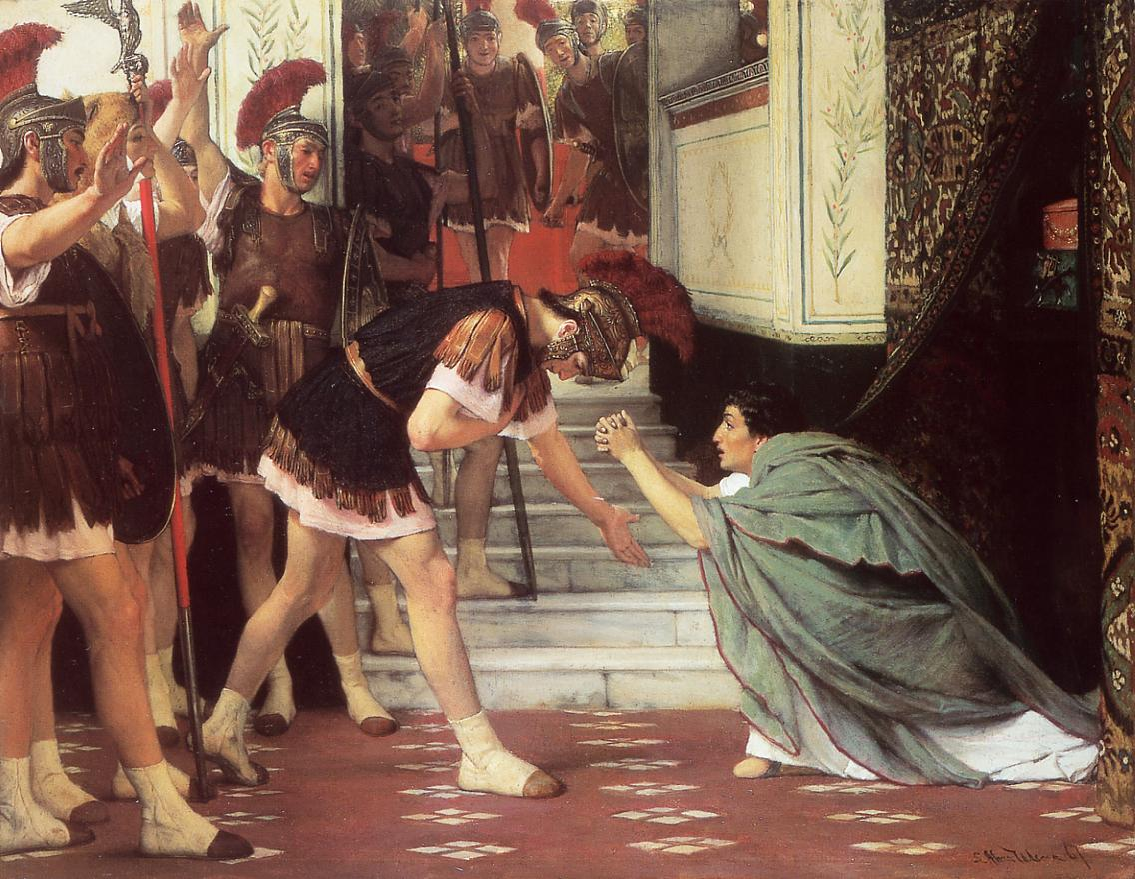
Proclaiming Claudius Emperor, by Lawrence Alma-Tadema

As a subscriber to Classical Journal, I regularly receive emailed reviews of new scholarly books concerning ancient Greece and Rome. The other day, for example, they sent me Michael Peachin‘s review of Claudius Caesar: Image and Power in the Early Roman Empire, by Josiah Osgood (Cambridge University Press, 2010). The only other notice I’d seen of the book was a drearily dutiful one in The Bryn Mawr Classical Review, so I was surprised that Peachin found some exciting points in the book. I’ll quote two of these points:

Several recent accounts of Roman emperors have sailed off on a new tack. Instead of attempting a traditional biographical interpretationof the man, and thereby also a chronicle of his reign, each of thesehas sought to present an emperor on his own terms, and/or to view himas he was perceived by certain groups of contemporaries (other than theelite authors, who usually monopolize discussion). Thus, Caligula was notout of his mind; he simply had no taste for playing republic, when thereality was despotism; and so, he fashioned himself overtly as a tyrant,regardless of the consequences – or perhaps precisely to elicit certainones of those (A. Winterling, Caligula: A Biography [Berkeley, 2011]).

When I was in graduate school, I took a seminar on Roman history in which the professor horrified about half the class by spending a day arguing that Caligula was probably not a lunatic. A few of my classmates were committed to the view of the third emperor presented in the ancient historical texts, and were appalled to hear a revision of that view; the others were committed to the idea that the only sort of history worth doing was social history that focused on the most numerous groups in a society, and so were appalled that we were spending so much time on the question of one man’s mental health. I was not in either of those groups, but loved the day and have been defending Caligula ever since. By the way, there’s a fine review of Winterling’s book in September’s New Criterion. I recommend it to the the general reader.

Peachin makes a point that I found especially fascinating:

Augustus, in fine, had played his part well; but as Osgood aptly demonstrates, he fated all the various players in the sequel to write their own scripts as they went. In any case, Osgood argues that Claudius quite actively tried to shape his own time as emperor, and that in doing so, he contributed materially to the development of the imperial ‘system.’ As we observe this particular emperor at work, we are also being nudged slightly away from Fergus Millar’s picture of a more passive, and perhaps generic, sort of monarch (The Emperor in the Roman World [Ithaca, 1977]): “…who the emperor was mattered” [136]). Still, Osgood sees quite clearly that Claudius (or any emperor) was indeed only one person; and hence, the princeps’ direct involvement with his subjects was perforce limited. Thus, when an emperor did choose to intervene, the event was so momentous as to carry an aura of the divine. That said, Claudius was no lone actor. We are reminded, throughout, that “…much of this emperor’s image, like any other’s, was constructed in dialogue with his subjects” (317.)

So, it was precisely because the emperor’s position was inherently weak that he inspired awe in his subjects. This is just the sort of paradox I can never resist.

Many readers will be familiar with the theory that historian Arnaldo Momigliano developed and that Robert Graves popularized in his novels about Claudius. Under this theory, Claudius wanted to phase out the principate and restore the old Republic. Peachin explains Osgood’s view of this theory with admirable concision:

Following Momigliano’s observations (Claudius: the Emperor and His Achievement [Oxford, 1934]), Osgood stresses the fact that Augustus’ uneasy amalgam of republic and empire remained a befuddling puzzle for Claudius (indeed, for every emperor). In particular, the quasi-retention of a republican state meant that a new imperial system of government could not be crafted with anything even approaching clarity, or in any detail. Thus, to start at the start, when Gaius [a.k.a. Caligula] was murdered, and had not indicated a successor, a conclusively ‘proper’ or ‘constitutional’ way forward was nowhere to be discovered. That notwithstanding, Claudius was quickly on the throne; but then, the awkward facts of his accession, not to mention the earlier vituperation of him by members of the Augustan house (and others), seriously undercut his authority. Attempting to counter such hindrances, and just generally in his zeal to rule as he found appropriate, Claudius was too fastidious. The result was a nasty paradox: “The loftier the goals the emperor set for his administration, the more likely he was to fail, and to open himself to allegations of incompetency, or even corruption. Yet precisely to try to win loyalty and increase his prestige, Claudius had to set loftier goals than those of Tiberius, even those of Caligula” (189).

Considering that the written law in Rome in 41 BC was predicated on the idea that the Republic was still functioning, and that Claudius owed the principate to the very group of men who had just violently murdered his predecessor, it would have been quite a challenge for him to find a way to present his accession as legitimate without appealing to the idea of a restored Republic. In no position to prosecute the assassins of Caligula, Claudius could only appeal to the right of tyrannicide, and thus evoke the two Brutuses, one who according to legend struck against the Tarquins in order to end the monarchy and establish the Republic, and the other who struck against Julius Caesar the Dictator in an attempt to prevent a new monarchy from ending the Republic. If there were people who took this forced imposture at face value, one can hardly blame Claudius.

Did astrology originate in cities?

Originally published on Los Thunderlads, 20 September 2011. Comment there.

I wonder if the first astrologers were city-dwellers. True, archeologists have found evidence that people who lived before the rise of cities paid close attention to the orbit of the Moon and identified constellations, and have argued that the orientations of temples and other religious structures from those days suggest that they attached a religious significance to the movements of heavenly bodies. Those activities are hardly surprising; farmers need a calendar to plan their year, as hunter-gatherers also need to plan their expeditions for times when game will be relatively plentiful and fruit ripe for the picking. Still, it might not be too much of a stretch to look at a society that invests heavily in maintaining and publicizing its calendar and to see a suggestion of something like what the western branch of organized Christianity used to call “natural astrology,” a set of ideas about ways in which heavenly bodies might influence the earth’s weather and various medical phenomena related to the transmission of disease.

Quite distinct from natural astrology are the various studies to which the Western Church used to refer as “judicial astrology.” That’s the part that includes horoscopes, sun signs, and the like. The difference matters when considering the origins of astrology; we have very ancient documents relating to the movements of heavenly bodies that seem to have some special significance and that predate the earliest references to judicial astronomy by centuries. So, I’ll use the terms.

It is sometimes said that our earliest evidence of judicial astronomy comes from Mesopotamia, but that is misleading. The nation state didn’t exist in those days; Ur and Lagash and Akkad and Babylon and the other urban centers that rose and fell in that region interacted with the political and economic systems of the countryside around them in a variety of ways, but in other ways they remained quite distinct. It is in such cities that we find the first documents describing judicial astrology.

If astrology did arise in cities, it arose in a social environment where markets were familiar. Its entire history would have taken place amid money, contracts, and production for exchange. That calls into question the assumptions that we discussed last year when this xkcd appeared:

Not to be confused with "selling this stuff to OTHER people who think it works," which corporate accountants and actuaries have zero problems with.

Some people fall into the assumption that, because markets promote something called “rationality,” they must therefore favor every form of reason and disfavor every form of unreason. However, the rationality which comes from markets is in fact something of a very narrow sort. A month after our discussion, we noted that Shikha Dalmia had put it very well: “Markets don’t reward merit, they reward value.” Dalmia summarizes the views of economist Friedrich Hayek:

In a functioning market, Hayek insisted, financial compensation depends not on someone’s innate gifts or moral character. Nor even on the originality or technological brilliance of their products. Nor, for that matter, on the effort that goes into producing them. The sole and only issue is a product’s value to others. Compare an innovation as incredibly mundane as a new plastic lid for paint cans with a whiz-bang, new computer chip. The painter could become just as rich as the computer whiz so long as the savings from spills that the lid offers are as great as the productivity gains from the chip. It matters not a whit that the lid maker is a drunk, wife-beating, out-of-work painter who stumbled upon this idea through pure serendipity when he tripped over a can of paint. Or that the computer whiz is a morally stellar Ph.D. who spent years perfecting his chip.

As markets are neutral as to the virtue or vice of economic actors, so too are they neutral as to the truth or falsity of the ideas that those actors bring as products for sale. If falsehoods are in demand, falsehoods will sell; if truths are not in demand, their bearers will go begging. The mouseover text for the xkcd represents a nod to this fact, and an attempt to wriggle out of its implications: “Not to be confused with ‘selling this stuff to OTHER people who think it works,’ which corporate accountants and actuaries have zero problems with.” That won’t do, since it assumes that we can assign a fixed meaning to the expression “works.” An investment advisor who believes in astrology may not be any likelier than other advisors to beat the market, but s/he may very well use that belief to “make a killing,” if s/he attracts clients who strongly value such a belief. In that case, astrology would not “work” in the sense that quantitative analysts officially recognize, but it would make the advisor every bit as rich as it would if it did meet their definitions of success. As for whether it makes the clients rich, well, Fred Schwed answered that one in 1940:

Once in the dear dead days beyond recall, an out of town visitor was being shown the wonders of the New York financial district. When the party arrived at the Battery, one of his guides indicated some handsome ships riding at anchor. He said, “Look, these are the bankers’ and brokers’ yachts.” “Where are the customers’ yachts?,” asked the naive visitor.

Clearly, markets have not dissolved belief in astrology, any more than the continued non-existence of the customers’ yachts has discouraged people going to brokers and bankers. If the practice of judicial astrology first arose in cities, it may in fact be a by-product of market society. Perhaps we might find that judicial astrology began, not simply as a more elaborate version of a natural astrology that had long been a feature of rural life, but as an attempt to understand market interactions and the power of the market. In that case, it would qualify as a school of economics. One may wonder whether judicial astrology would be the most absurd such school in practice today.