Saturday, September 3, 2011

Charitable Speech

Originally published on Los Thunderlads, 31 August 2011:

Today’s xkcd:

The late philosopher H. Paul Grice tried to make some of these rules explicit; his most famous attempt to do this can be found in his essay “Logic and Conversation,” published in his book Studies in the Way of Words (Harvard U.P., 1989 and 1991, pages 22-40.) Grice there lays down a set of rules in the form of a series of maxims. Grice begins with an overarching maxim that he calls the “cooperative principle”: “Make your contribution such as it is required, at the stage at which it occurs, by the accepted purpose or direction of the talk exchange in which you are engaged.” He breaks the requirements of the cooperative principle down into several maxims. So, one ought to be truthful, one ought to provide the listener with enough information to make it easy for the listener gather one’s meaning, one ought not to provide the listener with so much information that it is difficult to gather one’s meaning, one ought to provide information that is relevant to the conversation, one ought to express oneself clearly.

As Carole J Lee points out in her article “Gricean Charity: The Gricean Turn in Psychology” (Philosophy of the Social Sciences, 2006; 36(2), 193-218,) what Grice has given us in these maxims are not “universal norms of conversation” (203.) Still less, despite their phrasing, are Grice’s maxims commands that he would have insisted we follow. Rather, they are a sketch of the expectations that listeners tend to bring to a conversation. One tends to expect that a speaker will behave according to the maxims. When a listener finds that a speaker is systematically violating one or more of the maxims, that listener might react with laughter. That laughter shows that the listener, relying on the maxims, had constructed a different meaning than the one the speaker intended. Or, the listener might react with distrust or frustration, if reliance on the maxims has led him or her to a dead end. A charitable listener will bring these expectations to a conversation, assuming that each speaker is displaying the competence the maxims outline. To refuse to give a speaker credit for following Grice’s maxims is to fail to show that speaker the charity that makes cooperative communication possible.

In the strip, the hairless stick figure is frustrated by the hairy figure’s decision to “interpret an obviously sympathetic ‘I’m sorry’ as an apology.” Hairless seems to be frustrated that Hairy is not giving him* credit for following Grice’s maxims. The maxim of quantity requires that each speaker provide just that information the listener needs; the “Why?” in “Why? It’s not your fault” suggests that he is leaving out something essential, something which his sarcastic reply might supply. The maxim of relevance requires that each contribution to the conversation bear on the topic at hand; that Hairy would react to a conventional expression of sympathy as she does would suggest that she does not regard Hairless’ sympathies as relevant to a the topic of her mother’s misfortune. This rejection of Hairless’ expression of sympathy might well strike anyone as rather harsh.

Grice acknowledges that all of the properties that his maxims enjoin are complex. For example, he says of the maxim of relevance: “Though the maxim itself is terse, its formulation conceals a number of problems that exercise me a good deal: questions about what different kinds and focuses of relevance there may be, how these shift in the course of a talk exchange, how to allow for the fact that subjects of conversations are legitimately changed, and so on.” Of course, different cultures conceive of relevance in vastly different ways, a fact that serves as the starting point for many studies which question the usefulness of Grice’s maxims as a guide to the analysis of conversational behavior around the world.**

To the extent that Grice’s maxims are an attempt to outline the expectations listeners have of speakers, it is unsurprising that they do not lay injunctions upon listeners. If we were to complement them with a set of maxims that outline what speakers might reasonably expect from listeners, perhaps the first maxim would call for charity. That charity would be as multidimensional, and no doubt as culturally specific, as the properties Grice’s listeners expect from speakers. We might break our maxim of charity into several sub-maxims to give an idea of what the dimensions of this charity might be. First, assume that the speaker is performing his or her communicative project competently unless s/he provides evidence to the contrary. One might refer to Grice’s maxims in defining competent communicative performance. Second, assume that if the speaker has failed to perform his or her communicative project competently, any failures are as small as possible. So, if a speaker provides a logically invalid argument, a charitable listener might look for the simplest available premise that can be added to make the argument valid. Third, assume that the speaker is a person of goodwill. Under this assumption, one should try to find the least obnoxious possible interpretation for any unclear passages.

In the strip, Hairy has been uncharitable to Hairless, albeit in a rather subtle way. Hairless’ sarcastic response is of course a grossly uncharitable one. Grice was interested in sarcasm, which he saw as something that happens when when “the maxims are flouted.” What Hairy flouts in a subtle way is what Hairless responds by flouting in a massive way, the requirements of charity as I have tried to formulate them in the paragraph above. When speakers think that their listeners are refusing to follow these requirements, they often do respond with anger.

Two examples come to mind. Recently, I took part in a discussion thread on one of my favorite websites, the mighty Language Log. One of the mighty Log’s most distinguished authors, linguist Geoffrey Nunberg, posted a little piece about a newspaper columnby a writer named Kathleen Parker. Parker opens with a story about a brief encounter among a group of about ten strangers sharing an elevator at Presbyterian Hospital in New York City. Parker was among this group; apparently she had not seen any of the other riders before. Two riders did know each other, a woman and a man. The woman spent the moments of the elevator ride shouting at the man. In the course of her diatribe, the woman called the man a “motherfucker” several times. By the time this pair left the elevator, the woman had made it clear that the man was her son. Parker describes the discomfort that she and the other riders displayed while in the sharing the elevator with the shouting woman. She goes on to allow that coarse words are not in themselves particularly dangerous to the moral health of society, giving as an example of her willingness to tolerate them her relaxed response to a fellow guest at a very proper tea party who called sometime golf champion Tiger Woods an “asshole” in an incongruously “refined accent.” Still, Parker claims, “Lack of civility in words bleeds into a lack of decency in behavior… An “MF” here or an “FU” there might not constitute the unraveling of society, but each one uttered in another’s involuntary presence is a tiny act of violence against kindness, of which we surely could use more.”

There are any number of things one might say about this column. It’s interesting that the word “motherfucker” has come to be so frequently used as a symbol of obscenity without any evocation of the meaning of its root words that a mother could unselfconsciously apply it to her son. It’s puzzling what Parker means by a “refined accent”; she does say that the tea party guest was British, and evidently she was using what we used to called Received Pronunciation. But obscenity is now so common a feature of the speech of Britons of all classes that I cannot imagine any vulgar word being incongruous when spoken in any British accent.

What Professor Nunberg in fact chooses to do with the column is to accuse Parker of veiled bigotry. Noting that Parker’s response to the woman at the tea party had been to say that it would be all right for the woman to curse so long as she used her plummy accent while doing it, Nunberg says: “Now I can come up with at least five contexutal parameters that explain why the public harangues of the elevator expletiviste were obnoxious and offensive in a way that the English (one assumes) woman’s wasn’t. But the posteriority of the initial vowel of the epithet isn’t one of them.” This is a failure of charity on Professor Nunberg’s part; Parker’s use of the story to show her own relaxed attitude towards a non-threatening use of taboo words makes it clear that she was joking with the woman at the tea party. Lest we think that Professor Nunberg is himself joking, and merely pretending that he doesn’t see Parker’s joke, he goes on:

Why should it be? Would the incivility of the first woman’s rants have been tempered if she had called her son an asshole in an accent like Emma Thompson’s? Would the tea party lady’s reference to Tiger Woods be more offensive if the woman had sounded like Wanda Sykes? While we’re on the subject of vulgarity — and insolence — can we linger for a moment on the smug suburban gentility of that word refined? You’re left with the unsettling implication that the acceptability of allowing a naughty word to cross one’s lips depends, in part, on how thick they are.

Where does Professor Nunberg find this remarkably ugly implication? He seems to find it in Parker’s telling of the story of the elevator ride. Quoting key bits of the story, he comments:

The race and class of the woman and her companion weren’t specified, but readers might have been able to divine those attributes from the particular word Parker chose to report (or was that the only vulgarity the woman used?), helped along by the setting at Broadway and 168th Street and the mentions of the separated father and in particular of the young man’s “baggy drawers,” which presumably were intended to convey some relevant information. (If it had been an upper-middle-class white woman screaming “motherfucker” at a phat-pantsed white preppie, communicative cooperativeness would have obliged Parker to mention that fact lest the reader draw the wrong conclusions.)

None of the markers Professor Nunberg mentions in this paragraph is at all strongly correlated with race and class in New York City in 2011, as commenters on the post pointed out. Your humble correspondent mentioned a couple of items showing that, while “Motherfucker” may have originated among African Americans in the early twentieth century, it has been in general use among whites and others for decades. Professor Nunberg himself added to this list, strengthening my point (perhaps inadvertently.) Another commenter pointed out that Broadway and 168th is in the middle of Spanish Harlem, so that if that location tells us anything about the woman’s ethnicity it would suggest either Puerto Rican or Dominican heritage. Still others have pointed out that New York Presbyterian has more than one Manhattan location. One might also mention that Manhattan is rather a compact place, so a wide variety of ethnicities may be found in any of its hospitals. In the column, it is quite clear that “the “[mention] of the separated father” was “intended convey some relevant information,” and it is also clear what that information is. It is when the woman in the elevator mentions the man’s father that it becomes clear that she is his mother, and so it is when Parker quotes that line that she provides the punchline about the woman’s use of “motherfucker.” “Baggy drawers” or “phat pants,” like the use of “motherfucker” as an all-purpose obscenity, likely originated among African Americans and doubtless once was seen almost exclusively in African American communities, but one needn’t spend much time among young American whites to see that those days are long gone.

I appended many comments to this thread. Here are links to all of them, in the admittedly unlikely case that you are interested: 1, 2, 3, 4, 5, 6, 7, 8. I’ll copy the last one, because in it I finally got around to saying what I’d been trying to say all along:

@Daniel: 1. “This post doesn’t really need any more comments, but”- Yes, I sympathize. It’s as hard to stop as it is to stop eating a salty snack. An angry, angry salty snack.

2. “”drawers,” which I definitely associate with AAVE.” The structure of this debate seems to be, S1: Parker reports (item.) I associate (item) with African Americans. Therefore, Parker wants her readers to associate the people she is denouncing with African Americans.” In reply, S2: “I don’t associate (item) with African Americans.”

The least involved premises we can add to S1′s assertions to make them into a logically valid argument would surely be “I am the sort of reader Parker had in mind when she wrote her column, and she should have known that I would associate (item) with African Americans.” In the absence of any data about what Parker’s readers think of when they think of these various items or about what she has reason to expect from her readers, we have no reason to suppose that these premises are true.

3. “Rhetorically, that is clearly implying that the British lady did not have context or delivery issues.” Let’s remember the context and delivery Parker describes in her opening vignette. She was on an elevator, which is to say, in a confined space. A person entirely unknown to her joined her and several others in that confined space. For a few moments, this unknown person shouted obscenities. Anyone might feel uncomfortable in that situation.

By contrast, Parker met the British lady (if British and lady she in fact was***) in a situation where she was free to move about. Parker and this second person were introduced and participated in a conversation. In the course of that conversation, the second person used a word that often classified as objectionable. Parker did not object to it. In fact, she made a little joke to forestall objections.

What, then, is the simplest explanation of the difference between Parker’s response to the two situations? Is it that person 1 was of a different ethnicity than person 2, and that Parker is hostile to the ethnic group person 1 represents and friendly towards the ethnic group person 2 represents? Or is it that she would rather engage in a conversation at a social event with someone who clearly poses no threat to her than be trapped in an elevator with an angry stranger?

Granted, Professor Nunberg does make a nod in the original post to “at least five contexutal parameters that explain why the public harangues of the elevator expletiviste were obnoxious and offensive in a way that the English (one assumes) woman’s wasn’t.” His remarks before and after that, accusing Parker of “nudge-nudge allusions to race and ethnicity… the way people intimate someone’s Jewishness by saying they’re ‘very New York’” and of implying “that the acceptability of allowing a naughty word to cross one’s lips depends, in part, on how thick they are” does not leave much opportunity to put serious weight on these contextual parameters.

I’ll quote a bit from my second-to-last comment as well, since in it I brought up the points I’m making here about charity. In particular, I mention that a listener who is charitable to a speaker in one way may have to think ill of that speaker in another way:

@Peggy: “Keith M Ellis: “The whole point of dog-whistle racism is its deniability.” The whole point of accusations of dog-whistle racism is their unfalsifiability.” That’s going a bit far, surely. One ought to be charitable to people with whom one disagrees; one form of charity is to assume that when a logically defective argument can be made valid by the addition of an unspoken premise, the speaker has omitted the simplest possible premise that can achieve that result. So, suppose I ask you “Are the sidewalks wet?” and you reply, “They must be- it’s raining.” You’ve then made an argument that could be presented thus: (Premise) It’s raining. (Conclusion) The sidewalks are wet. By itself, this argument is invalid. The simplest way to make it valid is to add, as a second premise, “If it’s raining, the sidewalks are wet.” It would be an uncharitable listener who refused to make so small a cognitive leap in the course of a conversation.

Likewise, if one were to encounter an invalid argument that could most readily be made logically valid by the addition of a racist idea as an additional premise, it would be charitable to consider the possibility that the person making the argument has simply omitted that premise. I could mention some newspaper columnists who in fact do precisely that on a regular basis.

I’d extend that maxim of charity beyond the logical structure of arguments to the emotional response people exhibit to various stimuli. If, for example, Parker were usually happy when she was required to share a confined space with white people repeatedly shouting obscenities, but unhappy when an African American did the same thing, and she spoke as if no explanation was necessary for this difference in reaction, then charity to Parker would warrant the assumption that she was right, that the reason for the difference was in fact so simple that anyone could find it without an explanation. Charity to such a speaker might lead us to suspect the speaker of race prejudice.

Again, the column under consideration obviously does not meet this description. However, it is far from rare for people to exhibit emotional reactions to stories about misbehavior among African Americans that are not only grossly disproportional to the reactions the same people exhibit when they have heard similar stories about people of other ethnic backgrounds, but which also kick in long before any evidence is presented showing that the stories are even true. When that happens, it is neither irresponsible nor unfalsifiable to claim that racism is at work.

The more I thought about this exchange, the stranger it seemed to me that someone as learned as Professor Nunberg could take Parker to task for seeing a threat in a situation where she was confined in an elevator with a stranger. Granted, the idea that this represented a threat to civility in general is a bit underargued, but once one describes the situation it is hard to see what need there is to attribute Parker’s anger to racial prejudice. Yet shortly after, I noticed a news item describing an equally distinguished academic replicating Professor Nunberg’s behavior with some precision.

Evidently there is a woman named Rebeca Watson who writes a blog that is popular among atheists and other irreligious folk. In June, Watson attended a conference at which her fans were well represented. Very late on one of the nights of this conference, Watson found herself alone in an elevator with one of these fans, a man who made an awkward pass at her. Watson declined the man’s offer, and said on her blog that it made her uncomfortable. She gave it as an example of the wrong way for a man to approach a woman.

That, one would think, would be that. Were one to think so, one would be reckoning without Richard Dawkins. Professor Dawkins took it upon himself to post the following, as comment #75 in a thread on P. Z. Myers’ blog:

Dear Muslima

Stop whining, will you. Yes, yes, I know you had your genitals mutilated with a razor blade, and . . . yawn . . . don’t tell me yet again, I know you aren’t allowed to drive a car, and you can’t leave the house without a male relative, and your husband is allowed to beat you, and you’ll be stoned to death if you commit adultery. But stop whining, will you. Think of the suffering your poor American sisters have to put up with.

Only this week I heard of one, she calls herself Skep”chick”, and do you know what happened to her? A man in a hotel elevator invited her back to his room for coffee. I am not exaggerating. He really did. He invited her back to his room for coffee. Of course she said no, and of course he didn’t lay a finger on her, but even so . . .

And you, Muslima, think you have misogyny to complain about! For goodness sake grow up, or at least grow a thicker skin.

Richard

First, I would point out that Professor Dawkins has far more demands on his time than I do, so the fact that he would enter such a discussion shows that he uses his time even more foolishly than I do. In fact, even before the rise of the internet, Dawkins used to send unsolicited mail to people containing precisely these sorts of gratuitous insults. Some years ago, I read a magazine profile of a Harvard graduate who became a spokesman for Creationism. One day he opened his mail to find a letter from Richard Dawkins, whom he had never met, telling him that he was either an idiot or a villain, more likely a villain. I can’t recall the man’s name, since I’d never heard of him before or since. But for some reason Richard Dawkins wanted to send him hate mail.

Second, if Dawkins were as obscure a figure as am I, his remark would have been forgotten the moment comment #83 appeared in the same thread, from “Forbidden Snowflake”:

Dear Richard,

What right have you to bemoan the teaching of creationism in your country while people are dying of malaria in West Africa?
Seriously, this “you have no right to complain about your problems as long as there are bigger problems somewhere in the Universe” is nothing but a silencing tactic.

But of course Professor Dawkins is world-famous. And he tried to defend his remark, making it much worse, and again, making it still worse. So, there’s been a great deal of controversy.

Professor Dawkins’ invocation of Muslim women who live in countries where genital mutilation is practiced and severe form of Islamic law obtain might be expected to trigger anger from readers who identify with Rebecca Watson and assume that the professor is sharing information which he assumes to be relevant. If one were charitable to him, assuming that he was so competent a communicator that the relevance of the information to Watson’s post is likely easy to find, the premise one might supply would be that Watson is self-centered and unconcerned with the sufferings of such women.

Unsurprisingly, Watson’s defenders have responded in kind. Gawker quotes blogger Jen McCreight:

[It] makes me want to cry a little when you live up to the stereotype of a well-off, 70 year old, white, British, ivory tower academic. But let me spell it out for you instead of just getting mad (though I’ll do that too):

Words matter. You don’t get that because you’ve never been called a cunt, a faggot, a nigger, a kike. You don’t have people constantly explaining that you’re subhuman, or have the intellect of an animal. You don’t have people saying you shouldn’t have rights. You don’t have people constantly sexually harassing you. You don’t live in fear of rape, knowing that one wrong misinterpretation of a couple words could lead down that road.

Gawker quotes Watson’s expansion on McCreight’s remarks, then asking: “Can it really be that Dawkins has never been exposed to insults as odious as the ones mentioned by Ms. McCreight? As a jump-starter of the modern atheist revival, doesn’t Dawkins probably get a lot more threatening hate mail than all of his critics combined?” Considering that he’s a man who lives in the UK, I’d be willing to stake any amount of money on the proposition that Professor Dawkins has been called a “cunt” quite a few times in his life, and considering the amount of hate mail he gets I suspect that he’s been on the receiving end of the other words and claims frequently as well. Of course, words that have an association with a specific group wouldn’t have the same force when applied to someone outside that group, so Professor Dawkins is no contender for the title of Most Aggrieved. McCreight’s choice of words is still unfortunate, however.

At any rate, surely this whole matter calls for charitable reading. Only by dint of a most uncharitable reading of Watson’s original remarks could Professor Dawkins have thought it was appropriate to come at her in the way he did. A charitable reading of Dawkins’ words would not leave him looking at all good, but might have kept his critics from responding in anger when pity would have been not only more suited to the quality of his thought in this matter, but also more likely to inspire in him some feeling of embarrassment.

*Hairless stick figures in xkcd often turn out to be male, hairless ones female. Also, author Randall Munroe uses the first person singular to refer to Hairless in this strip, so I’m assuming it represents him.

**Some early examples of these studies are mentioned in Mary Louise Pratt, “Ideology and Speech Act Theory,” Poetics Today, vol. 7 no 1 (1986,) pages 64-65.

***She in fact was. I’d forgotten the relevant bit of Parker’s original column and was distracted by a side discussion in the thread about other properties of the tea party guest.

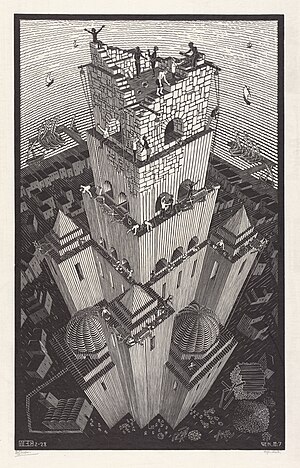
Before Babel?

Originally published on Los Thunderlads, 15 August 2011:


The Tower of Babel, by M. C. Esher

Fotb Maggie Jochild has reminded us of a study that was published in Science in April and publicized in The New York Times. Biologist Quentin D. Atkinson applied mass comparison methods familiar in genetic research to the analysis of phonemes, the sounds that languages use to distinguish one word from another. If a geneticist found the same pattens in a set of single-nucleotide polymorphisms that Atkinson found in the phonemes of the world's languages, that geneticist would likely conclude that the set represented descent from a single common ancestor. So, Atkinson suggests that all languages known to us, both those currently spoken as mother tongues and ancient languages known to us only through writings, descend from a language spoken in Africa tens of thousands of years ago.

When Atkinson's paper appeared, it attracted strong criticism from some of our favorite writers. To mention only the two posts about it that appeared on the incomparable Language Log, Mark Liberman analyzed Atkinson's methodology, and Sarah Thomason reproduced a letter that anthropologists Ives Goddard and Bruno Frohlich sent to Science, but which that journal refused to publish. Professor Liberman is lightly skeptical of Atkinson's methods, but optimistic that his conclusions might prove true, while Professors Goddard, Frohlich, and Thomason express more severe reservations.

For my part, I've often wondered how many languages were spoken when language was first spoken. For various reasons, it would be interesting if the idea of "a language" were familiar to the first generations of language speakers. The New York Times article says that Atkinson's work "implies, though does not prove, that modern language originated only once, an issue of considerable controversy among linguists."

I don't think it does imply that, actually. Even if it were proven that all languages available to us for study shared a common ancestor, it would not thereby be proven that "language originated only once." That language may well have been one of many languages spoken at the time, and may well have been descended from other languages spoken many millennia earlier. Consider the languages of ancient Italy. Latin is the ancestor of many languages spoken around the world today; the dozens of other languages that flourished on the peninsula before the rise of Rome have left no descendants. If it weren't for the written evidence that has come down to us from antiquity, we might be tempted to conclude that language originated in Italy only once, and in Latium. Extending the processes that singled Latin out as the only Italian language of the mid-first millennium BC to leave descendants back another 50,000 years to a time when all of our ancestors may still have lived in Africa, we can see that they may well have left only one language spoken at that period with descendants, even if at the time it had thousands of contemporaries.

Indeed, that might have happened even if that hypothetical mother tongue had not stood out among its contemporaries. To resume for a moment the parallel with Latin, before the late fifth century BC it would have been a rare observer who would have guessed that varieties of that language would grow into languages that would continue to be spoken for thousands of years after the language of the far wealthier and more powerful Etruscans had died without issue. Going back further, the people who spoke the language that was the common ancestor of the Anatolian and Indo-European language families probably lived sometime around the year 4000 BC. They were likely a rather scruffy group of nomads who lived in some of the less desirable corners of the Black Sea coast, what Moe the Bartender would no doubt call "one of them loser countries." * Even the early Romans would have seemed impressive set against them. Yet something like half the people in the world now speak one or another of the hundreds of languages that descend from theirs. If such an undistinguished group can launch a language that crowds out so many of its contemporaries over a period of 6,000 years, surely there is little we can say about the career in the world of a language that is likely 1o times that old.

*For an excellent introduction to what we know of the early Indo-Europeans and their predecessors, see David W. Anthony's The Horse, the Wheel, and Language (Princeton UP, 2007.) The author of the New York Times piece would have benefited greatly from reading Anthony's book; he cites a 2003 study by Atkinson which argued that "Indo-European was much older than historical linguists had estimated and hence favored the theory that the language family had diversified with the spread of agriculture some 10,000 years ago, not with a military invasion by steppe people some 6,000 years ago, the idea favored by most historical linguists. " Anthony treats of the theory that Indo-European came out of southwest Asia with agriculture in pages 75-82 of his book, and his analysis is devastating. While the languages we have available for study in historical time change ceaselessly and are as a rule considerably more diverse than the material cultures of the peoples who speak them, this theory requires proto-Indo-European to have entered Europe sometime shortly after 7000 BC, to have spread over that continent, and to have remained unchanged for 3000 years while an extremely wide variety of material cultures flourished there. This scenario is so remote from any attested elsewhere that it would qualify as a miracle. Moreover, all branches of the Indo-European family of languages include vocabulary descended from a rather large group of words related to wagons. The archaeological record makes it clear that wagons cannot have existed in Indo-European speaking areas much before 3500BC; the early entry hypothesis therefore requires that the Indo-Europeans, at a time when they had been separated from each other for three and a half millennia, simultaneously adopted the same vocabulary for this new invention. Again, if Atkinson's method compels this conclusion, Atkinson's method is reduced to absurdity.

As for the "military invasion" hypothesis, it is not "the idea favored by most historical linguists," as Anthony makes clear at several points. On pages 117-120, he introduces the first of a series of models of language diffusion developed by anthropologists working in contemporary African and Asian societies that have once and for all displaced the nineteenth century vision of the warlike Aryans, the "blond beasts" whose image has caused so much more harm than good. These models are a major theme of Anthony's book, and in fact allow far less significance to military invasions than does the early entry hypothesis.


Paradox of Humanism

Originally published on Los Thunderlads, 23 April 2011:

The oldest of Irving Babbitt’s published writings is an essay called “The Rational Study of the Classics,” which appeared in The Atlantic Monthly in March 1897 (in volume 79, issue 473, pages 355-365.) Babbitt, then in his early 30s, ends this piece with this paragraph:

There was never a greater need of the Hellenic spirit than there is today, and especially in this country, if that charge of lack of measure and sense of proportion that foreigners bring against Americans is founded in fact. As Matthew Arnold has admirably said, it is the Greek writers who best show the modern mind the path that it needs to take; for modern man cannot, like the man of the Middle Ages, live by the imagination and the religious faculty alone; on the other hand, he cannot live solely by the exercise of his reason and understanding. It is only by the fusion of these two elements that of his nature that he can hope to attain a balanced growth, and this fusion of the reason and the imagination is found realized more perfectly than elsewhere in the Greek classics of the great Age. Those who can receive the higher initiation into the Hellenic spirit will doubtless remain few in number, but those few will wield a potent force for good, each in his own circle, if only from the ability they will thereby have acquired to escape from contemporary illusions. For of him who has caught the profounder teachings of Greek literature we may say, in the words of the Imitation, that he is released from a multitude of opinions. (Quoted from pages 57-58 of Irving Babbitt: Representative Writings, edited by George A. Panichas; University of Nebraska Press, 1981.)

I find the paraphrase of Thomas รก Kempis strangely telling. Babbitt continually asserted the unity of human experience, arguing that the similarities between a properly lived human life in any one time or place and a properly lived life in any other time and place will prove to be more important than the differences between them. To sustain this idea, it is necessary to do two apparently contradictory things at the same time. On the one hand, one must hold as few opinions as possible and set as low a value as possible on opinions, since opinions are plainly among the things that set one person apart from another. On the other hand, one must have an opinion ready to account for each of the differences that sort people into groups.

Babbitt himself abounded with opinions. Sometimes the number of his opinions, the range of topics about which he had opinions, and the vehemence with which he expressed his opinions drove Babbitt to the point of self-parody. Perhaps the most obvious example of this is chapter six of his magnum opus, Rousseau and Romanticism (1919), titled “Romantic Love.” In this piece, Babbitt analyzes the love lives of various leading Romantic poets and novelists, arguing that the instability and eccentricity of some of their intimate attachments was the consequence of their theory of the will, and denouncing them ferociously for it. Babbitt hands down his verdicts on Novalis, Shelley, Chateaubriand, and any number of other figures in such dizzyingly rapid succession that one cannot but smile at his gusto. I’ve often suspected that Vladimir Nabokov had at some point read Babbitt’s withering attack on Novalis’ infatuation with the pubescent Sophie von Kรผhn and used it as the basis of Lolita.

I bring this up, not to beat old Babbitt when he’s down (he’s been dead since 1933, you can’t get much further down than that,) but to point out that I have fallen into the same dilemma. In December 2009, I reviewed the Ukulele Orchestra of Great Britain’s performance at the Albert Hall on this blog; in that review, I wrote the following sentences about Hester Goodman’s rendition of “Teenage Dirtbag”:

When I talked about Hester’s “Teenage Dirtbag” in my review of Live in London #1, I summarized it as a “ballad of adolescent lesbian angst”; it’s sobering to see how many visitors still come to this site having googled “hester goodman lesbian.” At the risk of drawing more of that traffic, I’ll say that the human race would be the poorer if some among us did not go through adolescent lesbian angst. I’d go so far as to label adolescent sexual angst in all its forms as an indispensable part of the human experience. Hester has produced a powerful testament to that form of adolescent angst, and my hat’s off to her for it.

In that “indispensable part of the human experience” and the proclamations that surround it, we have a humanistic opinion eliding the differences of sexual identity and sexual response that often sort people into groups. More recently, I asked here “Why do people have opinions about homosexuality?” In that post, I wondered whether there was any need for anyone to hold an opinion about that topic. Clearly those two posts don’t sit very comfortably together. Perhaps their apparent contradiction, like Babbitt’s apparent self-contradiction, points up a paradox that humanists in general are hard put to escape.


Tuesday, March 22, 2011

Libertarians and marriage


I've fallen far behind my usual pace in sharing my "Periodicals Notes"; that pesky offline part of the world keeps distracting me with things like work, family, etc etc. There's a great deal of work I ought to be doing right now, as a matter of fact, but I can't resist taking time to note a couple of pieces in the latest issue of The American Conservative. As you can see from the cover illustration, the magazine's contributors generally oppose official recognition of homosexual unions, holding that marriage is an institution that must be reserved for one elephant and one statue, and solemnized by a self-certified ophthalmologist.

I've long been puzzled by the low quality of arguments offered against same-sex marriage. Opponents have had a great deal of time to come up with reasons why only opposite sex couples should be allowed to marry. Their position is broadly popular, and they have at their disposal the resources of major religious organizations, conservative think-tanks, and much of the press. You'd think that with all that on their side, they would be able to produce an argument that would be at least superficially plausible. Yet, when asked to defend their position, supporters of the status quo trot out arguments that are so feeble they inspire, not even laughter, but sheer pity. At the outset of his article in this issue, "Stonewalling Marriage,*" Justin Raimondo describes the situation with admirable clarity:

Opponents of same-sex marriage have marshaled all sorts of arguments to make their case, from the rather alarmist view that it would de-sanctify and ultimately destroy heterosexual marriage to the assertion that it would logically lead to polygamy and the downfall of Western civilization. None of these arguments—to my mind, at least—make the least amount of sense, and they have all been singularly ineffective in beating back the rising tide of sentiment in favor of allowing same-sex couples the “right” to marry.

Raimondo goes on to offer what the cover advertises as "A Libertarian Case Against Gay Marriage." Indeed, it would be difficult to imagine a statement more typical of libertarianism than these paragraphs:

Of course, we already have gay marriages. Just as heterosexual marriage, as an institution, preceded the invention of the state, so the homosexual version existed long before anyone thought to give it legal sanction. Extending the authority of the state into territory previously untouched by its tender ministrations, legalizing relationships that had developed and been found rewarding entirely without this imprimatur, would wreak havoc where harmony once prevailed. Imagine a relationship of some duration in which one partner, the breadwinner, had supported his or her partner without much thought about the economics of the matter: one had stayed home and tended the house, while the other had been in the workforce, bringing home the bacon. This division of labor had prevailed for many years, not requiring any written contract or threat of legal action to enforce its provisions.

Then, suddenly, they are legally married— or, in certain states, considered married under the common law. This changes the relationship, and not for the better. For now the property of the breadwinner is not his or her own: half of it belongs to the stay-at-home. Before when they argued, money was never an issue: now, when the going gets rough, the threat of divorce—and the specter of alimony—hangs over the relationship, and the mere possibility casts its dark shadow over what had once been a sunlit field.

Who finds libertarianism appealing? This passage might suggest two groups. First, there are people who have known many couples who lived together for a long time, then married, only to go through a calamitous divorce shortly afterward. I suppose most Americans under the age of 60 could name at least a dozen such couples among their personal acquaintances. When I've seen the sequence long cohabitation/ brief marriage/ bitter divorce, I've always tended to explain the marriage as a desperate attempt to put some life back into a failing relationship. But some might look at the sequence differently, and wonder whether the relationships would have continued had the partners not ventured into the dread precincts of matrimony. Elsewhere in the issue, a piece* is built around the observation that young Americans tend to take many Libertarian ideas for granted; perhaps the changes in family structure that have shaped the lives of so many in recent generations have been part of the reason for this intellectual climate. Second, there are people who hold power in their relationships with others because they control economic resources on which those others depend. Some such people acknowledge the responsibilities that come with such power. Others not only refuse to accept those responsibilities, but do not like even to admit that they are in a position of power at all. For them, "money was never an issue," when the other parties in their relationships simply submitted to their will as regards it. Once those parties gain a share in the control of those resources as a matter of right, suddenly the terms of the relationship must be negotiated, not decreed by the "breadwinner." From the viewpoint of the deposed "breadwinner," this development might very well look like a departure from a "sunlit field" of liberty to the "dark shadow" of conflict, but the newly empowered "stay-at-home" may see matters quite differently.

Of course, it isn't only in the relationship between income-earners and their non-employed partners that one holding economic power may deny the existence of that power and see only the prospect of conflict when a subordinate acquires an independent standing. Employers often pretend that they are on an equal footing with their employees, and denounce trades unions as monstrous powers which bring disharmony into what would otherwise be an idyll of brotherhood. A fine example of this sort of thing can be found in this issue, in Peter Brimelow's "Less Perfect Unions," which denounces American schoolteachers for organizing their profession. When Raimondo reaches the heart of his argument against same-sex marriage, he presents a case that will be familiar to anyone who has followed the arguments gay liberationists have made over the years. Same-sexers, he argues, simply do not need "to entangle themselves in a regulatory web and risk getting into legal disputes over divorce, alimony, and the division of property." Opposite sex couples may believe that their shared interest in any children they may produce justifies such "entanglement"; Raimondo doesn't agree with them, but in deference to their assessment of their needs he stops short of the gay liberationist cry of "Smash the Family! Smash the State!," and does not call for the end of official recognition of opposite sex unions. He does take a page from the gay liberationist handbook, though, when he argues that same-sex marriage threatens to "take the gayness out of homosexuality." "By superimposing the legal and social constraints of heterosexual marriage on gay relationships, we will succeed only in de-eroticizing them." Raimondo extols the gay liberation movement of the late 1960s and early 1970s for its anti-state focus, and insists that the lack of official sanction and the formalization that goes with it have made homosexuality itself a force to resist the modern state. Same-sex marriage, Raimondo argues, would rob homosexual relations of their anarchic character, and reconstitute them as a pillar of the established order. Why, then, has the demand for gender-neutral marriage become central to the role of same-sexers in US politics? Raimondo has a theory:

The homosexual agenda of today has little relevance to the way gay people actually live their lives.

But the legislative agenda of the modern gay-rights movement is not meant to be useful to the gay person in the street: it is meant to garner support from heterosexual liberals and others with access to power. It is meant to assure the careers of aspiring gay politicos and boost the fortunes of the left wing of the Democratic Party. The gay marriage campaign is the culmination of this distancing trend, the reductio ad absurdum of the civil rights paradigm.

The modern gay-rights movement is all about securing the symbols of societal acceptance. It is a defensive strategy, one that attempts to define homosexuals as an officially sanctioned victim group afflicted with an inherent disability, a disadvantage that must be compensated for legislatively. But if “gay pride” means anything, it means not wanting, needing, or seeking any sort of acceptance but self acceptance. Marriage is a social institution designed by heterosexuals for heterosexuals: why should gay people settle for their cast-off hand-me-downs?

It seems a bit indecent to quibble with the content of so impassioned a peroration, especially considering that the issue is a more personal one for a same-sexer like Raimondo than it is for me. However, I would point out that he is shifting his ground here. Earlier, he had claimed that marriage evolved spontaneously among heterosexuals, who improvised various means of ensuring their interest in their children would be recognized. To the extent that the institution was "designed," that design came after the state intervened in this evolution and hijacked it to serve its own purposes. Now, he implies that marriage is suitable for heterosexuals after all, but not for homosexuals. This shift is important, because it shows him backing away from liberationism and its implication that people should discard the labels they wear, band together, and create a world free of the old restrictions. It leaves him all too much at home under the banner of "American Conservative."

*Sorry, subscribers only

Friday, March 11, 2011

An unexpected visitor

Originally published on Los Thunderlads, 25 August 2009:

Yesterday was the first day of school. I taught in the morning, Mrs Acilius had her classes in the afternoon. We went in together on the 7:14 AM bus. We have a little bath mat that Mrs Acilius’ assistance dog P—— uses to keep from sliding in the aisle of the bus. When we take the bus to school, I keep the mat in my office so that Mrs Acilius doesn’t have to carry it with her everywhere she goes.

At about 1 pm, I was doing paperwork at my desk. A student appeared in the doorway of my office. “Excuse me, sir, this cat was running around in the hallway.” She was holding a little kitten. “He’s bleeding rather badly. I have to go to class. Can you do something for him?” I stood up and reached for the kitten. She looked relieved and held him out to me. Of course he scratched my hand. I handed the kitten back to the student, then picked up P——’s mat. I held the mat out, the student set the kitten down in it. As I wrapped him up, she rushed off to her class.

So there I stood with an injured kitten. What next? I decided to take him to the nearest office and appeal for help. My office is about equidistant from the Dean’s office and the Psychological Science department office. I decided to take him to the Psychological Science office.

That turned out to be a very good decision. Their office assistant took the mat and set it on her desk. Also in the room were the department’s administrative coordinator, a couple of undergrads, and the department chair. They all gathered around the kitten in a circle. The office assistant got a little jar, filled it with water, and offered it to the kitten. The chair got a little cardboard box and put the jar and the kitten in it. The administrative coordinator had some dog food in her office for some reason; she put a couple of pieces of that in the box. The chair then went to his office and retrieved some tuna left over from his lunch.

The kitten was very badly hurt. He sniffed the water and the tuna, but didn’t take any of either. The student hadn’t been exaggerating when she said he was bleeding rather badly. The end of his tail was missing and blood was streaming out of it; there were deep scratches on the front of his chest. Someone I told about it this morning thought the kitten might have tangled with the hawk who circles the Quad; I’m sure that’s exactly what happened.

Seeing how much attention he was getting in the Psych office, I decided it was time to get back to work. So I excused myself and returned to my office. A half hour later, a psychology professor whose first initial is H came to my office. H—— told me that she had made a 4 PM vet appointment for the kitten. She swore up and down that she wouldn’t be able to keep him. “We already have two cats, and our place is so small- we can not have another cat.” Oh, she said, she would keep him for a while after he was released from the vet, but he’d have to live in the bathroom to keep him away from her two rambunctious older cats.

A few hours later, I was meeting with a student when Mrs Acilius came by my office. As Mrs Acilius waited for the end of my meeting, H—— saw her. H——- went up to Mrs Acilius and told her the whole story. She’d already taken the kitten to the vet. The vet had said the kitten was in shock from loss of blood and would need surgery to repair some mangled bones. H—— had agreed to pay for the surgery and was going to take the kitten in afterward, but she repeated that she could not have another cat. Apparently she went on and on about the sheer impossibility of taking another cat into her home.

When Mrs Acilius and I were leaving for the day at 4:30 or so, she reported what H—— had told her. I remarked that in my experience, swearing that you will not take in another cat is one of the stages in the process of adopting a cat. She said she suspected that it would prove to be the case here.

UPDATED, 16 October 2009:

After H—— paid for the cat’s surgery and kept him at home for a week or so, she gave him to the Psychological Science department secretary, M——-. I suspect H—— would have broken down and kept the cat herself, but the two cats she already has were so hostile to him that it was impossible. M——- has shown me several pictures and videos of the cat at home; he looks very happy and healthy. Unfortunately I haven’t been able to upload any of those pictures.

Since the cat’s new life started when he was taken to a psychologists’ office, Mrs Acilius and I thought he should be named him for a great psychologist. Mrs Acilius favored Watson, both for John Broadus Watson and also because it suggests Sherlock Holmes sidekick Dr Watson, a model whom a pet might emulate. I leaned toward Skinner, both for Burrhus Frederic Skinner and also because it suggests skinning, a hobby a cat might take up. When the cat was still with H——, we suggested these names to her. She said that the psychology faculty had also thought he should be named for a psychologist. Their chair had suggested Skinner, which she disliked, because, she said, “I don’t think behaviorism explains much.” So Watson was out, too. She and others favored Tedeschi, for Richard G. Tedeschi, who is known for a theory about how people who have suffered traumatic misfortunes can be transformed and grow stronger afterward. Since we knew that the cat had suffered a grave misfortune and hoped that he would have a bright future, that seemed appropriate.

M——- rejected all of those names. She named the cat Saint Ray, spelled StRay. Also appropriate.

The other day, M——- was showing me some pictures of the cat. She said she used to have a cat whose appearance and behavior were remarkably similar to StRay’s. A few years ago that cat had died, after 17 years with M——-. As she told me how much StRay reminded her of her late cat, she misted up and said that she almost thought that her late cat had sent StRay to her.

Weighty matters

Originally published on Los Thunderlads, 27 August 2009:

An artist's conception of the field pack ancient Roman soldiers wore

An artist's conception of the field pack ancient Roman soldiers wore

About seven years ago, I read G. R. Watson’s The Roman Soldier (originally published by Cornell University in 1969; I read a copy of the 1985 paperback reissue), a handbook summarizing what scholars in 1969 knew about life in the ancient Roman army. One point Watson made that I’ve been thinking about ever since I read the book had to do with the field packs Roman soldiers wore. Some scholars in Germany had tended to give very high estimates of the amount of weight that Roman soldiers had to carry, in some cases solemnly asserting that a legionary would march about all day with over a hundred pounds of equipment on his back. Dismissing these estimates as a self-evident absurdity, Watson tries to figure out just how heavy the pack might have been (in the 1985 reissue, that discussion is on pages 62-66, continued in note 140 on pages 175-176.) The best estimate he can come up with puts the average weight of the Roman soldier’s pack at 30 kilograms (66 pounds,)which happens to be identical to the standard for most modern armies.

Watson’s evidence suggests that throughout history armies have tended to increase the amount of weight soldiers have to carry, until the kit becomes so heavy that the high command has no choice but to cut it down to something weighing about 30 kilograms. I suppose that the obvious reason for this tendency is that many people are involved in deciding what it is essential that a soldier should carry in the field. Each of those people has ideas about items that should be on that list, and each sees the addition of his or her favorite item as a victory. When no one involved in decision-making at that level has to wear a full field pack on a regular basis, the decision makers have no immediate incentive to deny each other their little victories.

I wonder if there might not be a second, less obvious reason for this tendency. Ed Yong’s Not Exactly Rocket Science reports on a psychological experiment which indicates that people who are holding heavy objects tend to take matters more seriously than the same people do when they are not holding heavy objects. If this tendency is and has long been general among all humans everywhere, then we would expect that people who are interested in human behavior would have noticed it. Military commanders are interested in human behavior. Perhaps, noticing the overlap between the category “people holding heavy objects” and the category “people showing seriousness,” commanders have formed the idea that they could induce ever greater seriousness in their subordinates by weighing them down with ever more heavily loaded field packs.

If there’s anything to this speculation of mine, perhaps it is also part of the reason why there is so little protest against the spine-damagingly heavy backpacks that so many American children are forced to lug to and from school every day. Of course, many people are involved in deciding what a student should learn and do in school, and that is an obvious reason why the collection of textbooks and other materials students must transport on their persons tend to grow so heavy.

heavy backpackBut perhaps a belief that the weight of the physical burden one carries correlates directly with the seriousness of one’s attitude is also part of it. We want children to take school seriously. We have observed that people holding heavy objects tend to be serious. If holding heavy objects translates into seriousness, maybe holding even heavier objects will translate into even more seriousness! It will definitely translate into more back injuries, but isn’t that a small price to pay for keeping the wee ones doubled over for much of the day?

The American Conservative, September 2009

Originally published on Los Thunderlads, 31 July 2009:

american conservative september 2009One of the traits of this magazine is a tendency to grandiose theoretical explanations. That’s one of the things I like about it; I’m into grandiose theoretial explanations myself. It isn’t scholarly publication, and few of its authors have academic reputations to defend, so that tendency is not always restrained by the standards that keep theorizing under control in academic journals. Sometimes that means that the magazine runs a provocative, bold idea that might not have survived heavier editing; sometimes it means that it runs something that’s just plain cheesy quality. Again, I’m a pretty cheesy guy, so that’s okay with me.

For example, this month Ted Galen Carpenter points out that Americans by and large are quick to view political disputes in foreign countries in a romantic light, seeing the ghost of Thomas Jefferson in all sorts of unlikely figures. The next piece, by John Laughland, picks up on this same theme, explaining this American tendency as a sign of the influence of the philosophy of the Enlightenment. Laughland writes that “the key to understanding the West’s love of revolutions” is Westerners’ characteristic desire to believe that “politics can and should be a story with a happy ending.” This desire has run rampant in the West ever since the thinkers of the Enlightenment undermined the traditional Christian belief that the cosmos was ordered in a hierarchy, that justice was to be found in that hierarchy, and that the ruler’s power should be limited because the ruler was subordinate to God. Laughland identifies Immanuel Kant as “the greatest of all Enlightenment philosophers,” and summarizes Kant’s theory as a belief that ordinary reality is unknowable, but that the highest reality is “the categorical imperative- an abstract universally valid proposition that becomes real when it is willed.” Proceeding from these rather drastic simplifications, Laughland declares that:

The attraction of Enlightenment liberalism, therefore, is the result of a deep emotional need for a philosophical sytem that enables man to create a reality in a universe he does not understand and thereby to escape from the difficulties of the world by believing that everything will turn out all right in the end. Lacking a real belief in the afterlife, it also holds that the drama of human salvation is played out in this world, in history and politics.

Again, this is a severe oversimplification, but it has a certain plausibility. Where Laughland really goes off the rails is in his closing section, in which he argues that Enlightenment liberalism has an “objective ally” in Islam:

[B]ecause it has no priesthood, Islam, and especially Shi’ism, is fundamentally a “democratic” religion comparable to Puritanism and other forms of Presbyterianism. There is no established hierarchy; the Koran must be read equally by all. Of course Allah is supreme and Islam demands absolute submission to Him; on the face of it, this seems the opposite of the liberal model in which the individual is subjected only to himself. But this very submission is egalitarian, creating a mass of individuals who are equal in their abstractness. Moreover, God’s will is [merely] will, it has no correlation with natural law as in the Christian or Jewish traditions. Islam is therefore a profoundly voluntarist religion. Because Allah is absolutely transcendent and unknowable, he is like the Kantian thing-in-itself: mere command.

Laughland claims that the influence of Kant and other Enlightenment thinkers is one of the reasons why Westerners behave as they do when confronted with complex political challenges. So to say that Islam is an “objective ally” of this influence, and to liken it as an intellectual tradition to the theories of Kant (as parodied above,) is to say that Muslims behave as they do in world affairs, at least in part, because Islam, as an intellectual tradition, is “fundamentally” anti-hierarchical. Laughland’s claims strike me as under-argued, to say the least. If Laughland were analyzing the works of particular Muslim thinkers and comparing them, on the one hand, with the works of traditional Eastern Orthodox and Roman Catholic Christians who had addressed similar questions, and on the other hand with the works of post-Enlightenment Westerners, then one might imagine that he could have formed an hypothesis that traditional forms of Christianity offer certain intellectual resources unavailable to followers of either of the other two traditions. Further study might have tested this hypothesis. What makes this passage cheesy is, first, the lack of any indication that Laughland has conducted such a study; second, his failure to limit the scope of his generalizations to some definite group, such as a particular set of texts, making instead blanket assertions about all of Islam; and third, the absence of any identifiable interlocutor to whom the passage might be addressed. Laughland is not addressing himself to anyone who might contradict him or challenge his views, but is handing down pronouncements that no implicit reader would be in a position to try to disprove.

William S. Lind’s piece about the Predator unmanned fighter aircraft shows a similar tendency to the grand theoretical explanation. At least Lind’s theory is coherent, and germane to the subject at hand. He quotes Colonel John Boyd, United States Air Force, “America’s greatest military theorist,” who points out that a commitment to build a big ticket weapons system puts a contestant in an unconventional war at a disadvantage:

Because complex weapons are expensive, they are usually in service for a long time, sometimes decades. Soon after their introduction, most if not all of their operating characteristics are known, especially in the age of the Internet. Our opponents can invent and deploy generations of simple countermeasures in the lifetime of one high-tech system. They are “outcycling” us, in Boydian terms; they can go through many cycles of observing, orienting, deciding, and acting against our weapons systems while the systems go through only a single cycle. Boyd argued that there are few more certain prescriptions for defeat.

Richard Gamble reviews The American Patriot’s Bible, by Richard G. Lee. Gamble is the author of The War for Righteousness: Progressive Christianity, the Great War, and the Rise of the Messianic Nation, and defends a very old-fashioned form of Lutheranism against all forms of nationalism. Gamble declares that the book under review “attempts with breathtaking audacity to synthesize Americanism and Christianity,” ignoring the wariness of this-world attachments at the heart of the Christian message. Lee and his staff, Gamble charges, have searched the Scriptures selectively, looking only for what they wanted to find, and have come up with a “Christianity of power, moralism, and worldly success, not one of persecution, cross-bearing, and division.” Lee’s book “combines the things of God and the things of Caesar at the very point where they most need to be kept apart. When the City of Man sets up Americanism as its faith, the City of God is forced to dissent.”

Daniel Larison reviews Adrian Goldsworthy’s How Rome Fell: Death of a Superpower. For a long time, scholars described the events around AD 476 as the ”fall of the Roman Empire.” More recently, the dominant fashion was the “transformationist” approach, which emphasized the change of Europe’s economic and political systems at the ground level in those years, suggesting that the formal dissolution of the western Empire was a less significant event than it might have seemed. Now scholars are reacting against the transformationist approach, arguing that titles like The Rise of the European Economy seriously misrepresent a period which was in fact characterized by violent upheavals and immense social dislocations. Larison says kindly that Goldsworthy, a military historian who shows little or no interest in the economic, religious, and social changes that the scholars engaged in this debate have studied, is “critiquing both sides from a distance.”