Saturday, October 1, 2011

Mr O's "anti-nuclear imperialism"

Originally published on Los Thunderlads, 29 September 2011. Comment there.

Let me tell you about a better way, a way that protects the purity of our precious bodily fluids.

The late September issue of Counterpunch (available to subscribers here; the newsletter’s website is here) includes a fine article by Darwin Bond-Graham titled “The Obama Administration’s Nuclear Weapons Surge.” While Mr O has made many remarks declaring that nuclear weapons are bad and the world would be better off without them, he has in fact “worked vigorously to commit the nation to a multi-hundred-billion-dollar reinvestment in nuclear weapons, mapped out over the next three decades.” Bond-Graham analyzes the New START agreement between the USA and Russia. Though the publicity surrounding New START presented it as an arms-reduction treaty, Bond-Graham contends that it is nothing of the kind. “On balance, the nominal reductions in nuclear weapons required by New START are insignificant when compared to the multibillion-dollar nuclear (and strategic non-nuclear) weapons programs committed to in the treaty’s text.” Indeed, Bond-Graham classifies New START as an “arms-affirmation treaty.” Mr O and his allies in the upper echelons of the congressional Democratic leadership were able to market New START as a disarmament agreement and to enlist the support of Americans who usually oppose nuclear weapons, even though “the treaty does not actually require the destruction of a single nuclear warhead.” Bond-Graham also goes into depth on various other programs through which Mr O has managed to increase spending on nuclear weapons, to reorient the USA’s nuclear weapons programs towards potential use in conflict, and to strip away inhibitions against nuclear first strikes by the USA.

For Bond-Graham, Mr O’s anti-nuclear public statements not only represent a rhetorical device to “neutralize” the “anti-nuclear and antiwar groups that so effectively exposed [George W.] Bush’s plans” to pursue policies similar to those of the current administration, but also constitute the foundation of a strategic orientation that Bond-Graham dubs “anti-nuclear imperialism.” This orientation, ostensibly based on abhorrence of nuclear weapons, in fact promotes the development, maintenance, and deployment of such weapons. Remember the claims that the Bush-Cheney administration made about Saddam Hussein’s alleged “Weapons of Mass Destruction” programs in 2002-2003, and the meaning of the phrase “anti-nuclear imperialism” becomes all too clear.

The contextualization fairy

Originally published on Los Thunderlads, 23 September 2011. Comment there.

Recently, John Holbo posted two items (here and here) on Crooked Timber about something odd in American politics. Right-wing politicians in the USA quite often make public statements that would, if taken at face value, suggest that they are far more extreme in their views than they in fact are. So, Professor Holbo finds remarks from Texas governor Rick Perry which, taken literally, would imply that Mr Perry thought that Texas should secede from the USA, that all federal programs established since 1900 should be abolished, indeed that there should be no government at all. Mr Perry obviously does not believe any of those things, so obviously that only his committed opponents try to take him to task for making such extreme remarks. This is not unique to Mr Perry, but is a usual pattern for right-wing US politicians.

What makes this so odd is that, while it is common for right-wing American politicians to exaggerate the radicalism of their views and for the public to realize that this is what they are doing, Professor Holbo can find no examples of their left-leaning counterparts doing the same thing. A Democratic or leftist candidate who makes a radical-sounding statement likely means that statement to be taken at face value, and it certainly will be taken at face value by most observers.

Many commentators on American politics explain the right-wingers’ habit of making extreme sounding statements for which they do not expect to be held responsible as an effort to move the “Overton Window.” The Overton Window, named for the late Joseph P. Overton, is the range of ideas that the people who hold sway in a given political culture hold to be acceptable at a particular time. Only ideas within the window are likely to be put into effect. The window shifts back and forth, as some ideas that had once seemed outlandish begin to seem mainstream, while other ideas that had once seemed mainstream begin to seem outlandish.

Key to the Overton Window is the idea of contextualization. The idea of devolving Medicare, the program that ensures that most Americans over the age of 65 will be able to pay for health care, to the states may seem outlandish to many in the USA, but compared to the idea of large states seceding from the Union it is quite moderate. The idea of shifting the revenues of Social Security, the program that provides a guaranteed income to most Americans over the age of 65, from current benefits to private savings accounts may seem outlandish to many in the USA, but compared with the idea of abolishing the entire welfare state it is quite moderate. Other policies favored by powerful interests on the right end of the political spectrum may also seem outlandish, but compared with anarchism they too are quite moderate. So, within the context of the extreme remarks for which they are not called to account, rightists can gain a hearing for policies which they do seriously advocate.

Contextualization has also been on the mind of cartoonist Zach Weiner lately. Here’s a recent installment of his strip, Saturday Morning Breakfast Cereal:

Both Professor Holbo and Mr Weiner brought one of my daily reads to mind. Blogger Steve Sailer made a very interesting observation about contextualization the other day, in a post called “White Triumphalism in Gentrifying DC“:

Ethnic change in Washington D.C. has gone so far that white hipsters are getting cocky about rubbing the noses of poor blacks in the new white dominance. The Washington Post reports:

While I sat for the better part of an hour — okay, perhaps longer than that — outside H Street Country Club on Saturday enjoying a few libations as the Northeast corridor’s fabulous festival unfolded around me, I watched club owner and impresario extraordinaire Joe Englert [a white guy] and his compatriots do a rather brisk business in a repurposed piece of D.C. political memorabilia.

His navy-blue T-shirts bearing the legend “Mayor Barry: Making a great city even greater” were going gangbusters.

That would be the official logo of Marion Barry’s 1986 re-election campaign. An original sign, incidentally, hangs above the stairs down into the basement of Englert’s Capitol Lounge on Pennsylvania Avenue SE.

Most of the folks I watched buy the tees were, shall we say, not in Barry’s base demographic.

While Englert acknowledged the shirts’ appeal to master ironists, he insisted he printed up the shirts out of appreciation for Barry, not to mock him.

”I think people, even newcomers, sort have a fond view of him,” he said. “He’s a folk hero. He’s as close to Johnny Appleseed as you’re going to get here.”

This doesn’t strike me as polite or prudent. Considering what happened to Matthew Yglesias in May just for being a white man walking down the street in D.C. at night, being a white man walking down the street wearing an intentionally racially insulting T-shirt, apparently thinking that poor blacks are too stupid to realize you are mocking their demographic defeat, sounds like a really bad idea.On the second thought, a lot of these hipsters might not even get that they are racially gloating over the upcoming economic cleansing to Baltimore of the remainder of D.C.’s poor blacks. They possess elaborate conceptual vocabularies for thinking well of themselves, so they might even believe that they believe that “folk hero” nonsense.

People who weren’t living in the USA in the early 1990s may not see why a Marion Barry T-Shirt is an insult to African American residents of the District of Columbia. Mr Barry was elected to a third term as Washington, DC’s mayor in 1986, then in January 1990 videotaped in a hotel room with an ex-girlfriend smoking crack cocaine. When the police burst in to the room and arrested him, the mayor muttered “Bitch set me up!” After his release from prison in 1992, Mr Barry was elected to the DC city council, and in 1994 he was once more elected mayor. Many people were appalled by that 1994 reelection; I for one suggested that if the District of Columbia were ever to become a state, its Latin motto should be “Illa Canis Me Implicavit.” In 1997, the US Congress stripped the mayor of his powers, leaving Mr Barry little choice but to stand down in the 1998 election. Despite a 2002 incident in which police found traces of cocaine and marijuana in Mr Barry’s car, he was in 2004 again elected to the DC city council; despite his 2005 guilty plea in a tax evasion case, he was reelected to the council in 2008, and he still sits there. Mr Barry is a paradox. At one and the same time, he is a popular figure among African American voters in the District of Columbia, and an embarrassment to them.

Mr Sailer is well positioned to understand this paradox. He spends a great deal of time trying to promote a definition of “race” as “a partly inbred extended family.” How many people do not have family members whom they love, support, and find embarrassing? And how many would support the police if they saw a relative being arrested, however justly? One night when I was a little kid, the police came to our house and hauled my brother away in handcuffs because of unpaid traffic fines. My mother, a deeply conservative, pro-authority sort of person, found herself screaming at the arresting officers that they were no better than the Gestapo. Fortunately my father had the presence of mind to hold her back, or she would likely have gone to jail as well. If my brother had subsequently run for office on an anti-police platform, we would have been sorely tempted to vote for him, for all that we knew that the whole thing really was his fault for not having paid those fines. Within the context of a family under assault, whether by police dragging its members off to jail or by relatively wealthy, privileged people taking possession of territory that once was theirs, it is easy to understand why the “ironic” T-Shirts could only be read as a deliberate provocation.

Mr Sailer speculates that the “hipsters” may have made use of their “elaborate conceptual vocabularies for thinking well of themselves” to tell themselves that they are doing something other than taunting the people who used to live in the neighborhoods where they now predominate. That makes a great deal of sense to me. One of the great films of the 1990s was Crumb, Terry Zwigoff’s documentary about underground cartoonist R. Crumb. Watching that film, I laughed out loud when a commentator, pointing to some cartoons of Mr Crumb’s in which crudely drawn black characters gorged themselves on watermelons and were treated as potential meals for cannibals, said “This is actually an attack on black people.” What made me laugh was that word “actually,” implying as it did a contrast with something else that it apparently was. Obviously it was an attack on black people, only Mr Crumb’s “hipster” fans putting their “elaborate conceptual vocabularies for thinking well of themselves” into overdrive could have seen it as anything else.

The last paragraph of Mr Sailer’s post puts an unexpected spin on what went before. He writes:

By the way, in 25 years, will the next generation of white hipsters ironically wear vintage 2008 “Obama: Hope and Change” t-shirts? They might not be worth much right now, but you should stock up on them because they could be an ironic gold mine someday.

Mr O doesn’t seem like the sort of fellow who would be caught in a hotel room smoking crack and muttering “Bitch set me up,” so bracketing him with Mr Barry strikes me as rather odd. In fact, just about the only things I can think of that the president has in common with Mr Barry are party affiliation and skin color.

This brings us to Mr Sailer’s own self-presentation, and his rhetorical project. I value his blog greatly; he seems to have a very fertile imagination, and almost every day he posts some or other interesting, novel-sounding idea for consideration. It’s the sort of thing that sometimes goes on in the common areas of a well-functioning graduate program. Lots of the ideas are less novel than they sound, lots of others are wrong, and all of them are shot through with the author’s biases, but that’s all right- the common purpose of research, debate, and the scientific method is to sift through proposals, eliminate the dead ends, and refine the promising ones. I wish there were many bloggers as creative and as uninhibited as Mr Sailer, and that they all had commenters who would bring real knowledge to bear in helping to move from the “interesting idea” stage to the “might be worth looking into” stage. When Mr Sailer started allowing comments, he did have some commenters who would respond to his posts with citations of academic journal articles and other publications that had already explored his ideas, and some who weren’t afraid to write “I call bullshit on all of this.” As time has passed, though, those commenters have disappeared. Most of those who remain seem committed to the idea that they have joined Mr Sailer as part of a plucky band of truth-tellers who have innocently made observations of the plain facts before them, only to be set upon by an unreasoning horde enforcing an absurd orthodoxy.

Making matters much worse is the particular nature of the preconceptions this crowd is so eager to reinforce. Mr Sailer is interested in the differences among groups of people, most definitely including differences that can be accounted for by genetic inheritance. So, some of the biases that a well-worked out scholarly version of one of his ideas would drain away, but that the first proposal stage includes very prominently, are biases that bear on questions of race and ethnicity. It is not unusual for Mr Sailer to write posts in which he expresses sympathy for beleaguered African American communities, as he does in the post quoted above. However, he very often seems to court the charge of racism.

For example, in a recent post he discussed a table comparing the fifty United States to each other by the percentage of each state’s African American population that was dependent on public benefit. There are any number of public policy discussions in which such a table would be of vital importance, and Mr Sailer’s discussion includes some interesting speculation about the differences among the states and some useful criticism of the statistical methods used in the compilation. Indeed, when the author of the table revised it in accord with Mr Sailer’s criticism, his attempt to explain why Texas was at one extreme collapsed as the corrected table showed that Texas actually belonged in the middle. In his updated version of the post, Mr Sailer leaves in the discredited speculation, then adds “Now, Texas blacks falls out of the better reaches and right into the middle of the pack. Oh, well … My explanation above sounded highly persuasive while I wrote it.” So, he makes legitimate contributions on an important topic, and promptly acknowledges an error with good humor. What’s wrong with that? Well, for one thing, the title of the post is “Which state has the best blacks?” And he labels partial tables showing the states with the biggest and those with the smallest racial disparity in rates of dependency as “Best blacks relative to local whites” and “Worst blacks relative to local whites.” So he’s contextualizing his discussion as a verdict on the African American populations of the various states. In view of the awareness he showed in the Marion Barry T-Shirt post, it’s hard to believe that Mr Sailer did not know that he would give offense by posing as the judge of black America.

I suspect that Mr Sailer’s habit of framing his writing in a way that is likely to provoke charges of racism goes back to the idea of the plucky band of truth-tellers who have innocently made observations of the plain facts before them, only to be set upon by an unreasoning horde enforcing an absurd orthodoxy. This idea is, I suspect, Mr Sailer’s business model. To leverage it into an income adequate to support himself and his family in Los Angeles, Mr Sailer must strike his readers as a reasonable person, behaving innocently, and he must have opponents who accuse him of being a sinister person, propagating hate.

It’s entirely up to him to seem reasonable, and he promotes that impression not only by saying reasonable things at regular intervals but also by describing his own innocent, harmless nature. In one recent post, he describes himself thus: “I’m very good at verbal logic, and have a certain gift for insights that other people wouldn’t come up with, but I’m not a meticulous thinker. I make lots of mistakes. I’m more of a let’s run it up the flagpole and see if anybody salutes thinker. In contrast, say, Charles Murray’s brain works like a BMW V-12: powerful and precise. Mine’s a jalopy that might surprise you and win the race or might break down on the starting line and go nowhere.” The self-deprecating tone of this helps to make Mr Sailer seem harmless, while the nod to racial theorist Charles Murray invites suspicion. In another recent post, he characterized himself even more modestly, as one who is “the perpetual extremely nice eighth grader” in person, though his writing often rubs people the wrong way.

As for the second half of Mr Sailer’s plan, one can’t actually count on one’s opponents to accuse one of being a sinister, hateful person. It’s true that groups like the Southern Poverty Law Center need to brand people as racist in order to raise funds, and so they lend him a helping hand from time to time. And there’s nothing to stop someone from setting up a blog devoted to denunciation of Mr Sailer; I’m not entirely sure that the site I’ve linked to there is not maintained by Mr Sailer himself, in an effort to keep his fans thinking that they are under siege. But to attract the sort of hostile attention that he needs, Mr Sailer must bait his potential adversaries regularly. It’s frustrating for those of us who find value in his substantive contributions.

Brian Barder is a nice guy

Originally published on Los Thunderlads, 22 September 2011. Comment there.

Political blogging is not generally regarded as an activity that brings courtesy to the fore, but retired UK diplomat Brian Barder never fails to show good manners. Though most of the topics he discusses are outside my usual circle of interests, I read him regularly, since it is such a pleasure to see politeness at work.

For example, the other day Brian Barder* posted a proposal about reforming the UK constitution. Brian Barder has considerable expertise on this subject, and his proposal is sufficiently close to his heart that he has been working to promote it for some years. My knowledge of the UK constitution is limited to what I picked up during the years I took The Economist, and as someone who does not live in the UK my stake in its reform is close to nil. Yet I took the liberty of posting comments (here and here) in which I expressed skepticism about the practical aspects of his plan. Brian Barder would have been perfectly within his rights to ignore my uninformed remarks, or even to dismiss them icily, yet in fact he took the time to provide detailed responses to each of them. In fact, he even emailed me to make sure that I knew he had done so. Such generosity is not to be forgotten.

*I’d call him “Mr Barder,” but that isn’t actually his name. He holds a knighthood, and so the proper courtesy title for him is “Sir Brian.” I cannot bring myself to refer to any living person in that fashion; to me, it suggests only Monty Python. So the only respectful way I can name him is as “Brian Barder.” This is a shame, since Brian Barder is himself so scrupulous a user of courtesy titles that he titled his condemnation of the Oslo massacre “There are no lessons to learn from Mr Breivik.” If Brian Barder can bring himself to give the correct title even to the murderer of dozens of helpless innocents, it seems churlish of me to withhold his title from him, yet I must, I must.

Some interesting remarks by Michael Peachin on a new book about the emperor Claudius

Originally published on Los Thunderlads, 21 September 2011. Comment there.

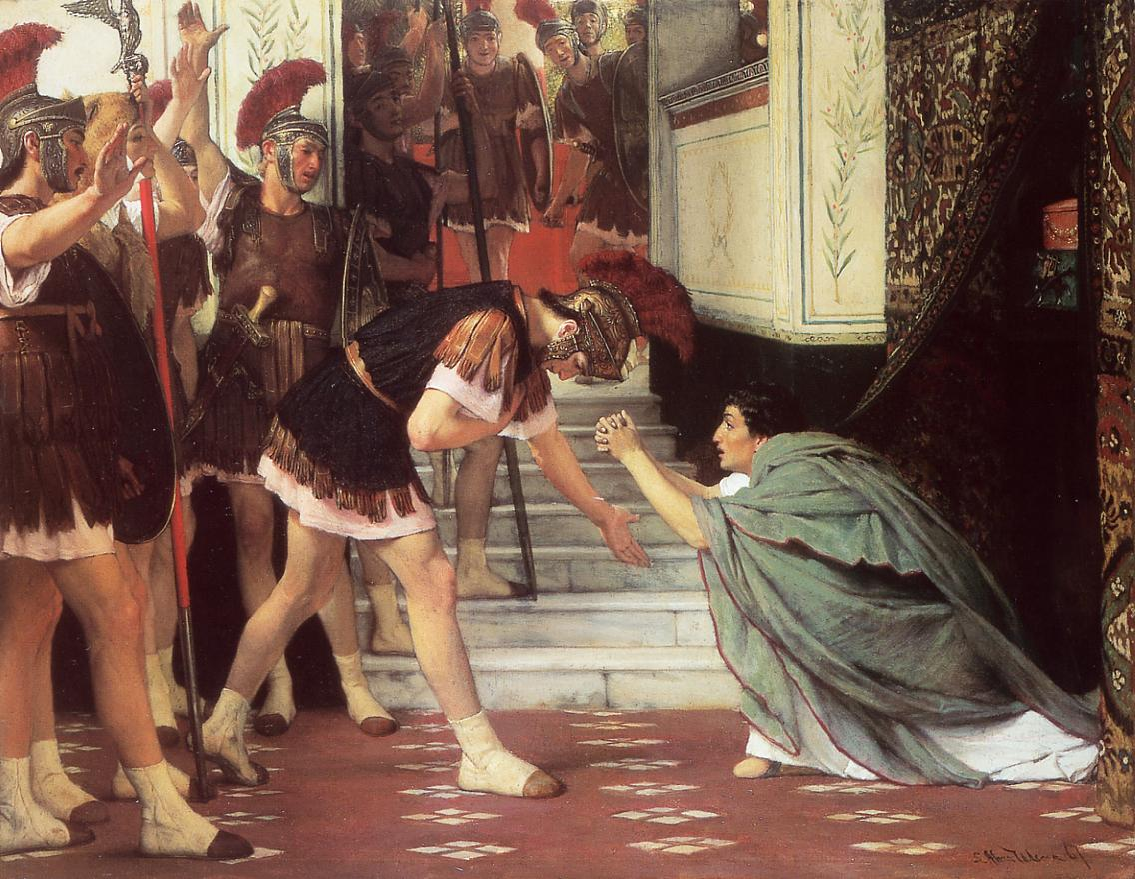
Proclaiming Claudius Emperor, by Lawrence Alma-Tadema

As a subscriber to Classical Journal, I regularly receive emailed reviews of new scholarly books concerning ancient Greece and Rome. The other day, for example, they sent me Michael Peachin‘s review of Claudius Caesar: Image and Power in the Early Roman Empire, by Josiah Osgood (Cambridge University Press, 2010). The only other notice I’d seen of the book was a drearily dutiful one in The Bryn Mawr Classical Review, so I was surprised that Peachin found some exciting points in the book. I’ll quote two of these points:

Several recent accounts of Roman emperors have sailed off on a new tack. Instead of attempting a traditional biographical interpretationof the man, and thereby also a chronicle of his reign, each of thesehas sought to present an emperor on his own terms, and/or to view himas he was perceived by certain groups of contemporaries (other than theelite authors, who usually monopolize discussion). Thus, Caligula was notout of his mind; he simply had no taste for playing republic, when thereality was despotism; and so, he fashioned himself overtly as a tyrant,regardless of the consequences – or perhaps precisely to elicit certainones of those (A. Winterling, Caligula: A Biography [Berkeley, 2011]).

When I was in graduate school, I took a seminar on Roman history in which the professor horrified about half the class by spending a day arguing that Caligula was probably not a lunatic. A few of my classmates were committed to the view of the third emperor presented in the ancient historical texts, and were appalled to hear a revision of that view; the others were committed to the idea that the only sort of history worth doing was social history that focused on the most numerous groups in a society, and so were appalled that we were spending so much time on the question of one man’s mental health. I was not in either of those groups, but loved the day and have been defending Caligula ever since. By the way, there’s a fine review of Winterling’s book in September’s New Criterion. I recommend it to the the general reader.

Peachin makes a point that I found especially fascinating:

Augustus, in fine, had played his part well; but as Osgood aptly demonstrates, he fated all the various players in the sequel to write their own scripts as they went. In any case, Osgood argues that Claudius quite actively tried to shape his own time as emperor, and that in doing so, he contributed materially to the development of the imperial ‘system.’ As we observe this particular emperor at work, we are also being nudged slightly away from Fergus Millar’s picture of a more passive, and perhaps generic, sort of monarch (The Emperor in the Roman World [Ithaca, 1977]): “…who the emperor was mattered” [136]). Still, Osgood sees quite clearly that Claudius (or any emperor) was indeed only one person; and hence, the princeps’ direct involvement with his subjects was perforce limited. Thus, when an emperor did choose to intervene, the event was so momentous as to carry an aura of the divine. That said, Claudius was no lone actor. We are reminded, throughout, that “…much of this emperor’s image, like any other’s, was constructed in dialogue with his subjects” (317.)

So, it was precisely because the emperor’s position was inherently weak that he inspired awe in his subjects. This is just the sort of paradox I can never resist.

Many readers will be familiar with the theory that historian Arnaldo Momigliano developed and that Robert Graves popularized in his novels about Claudius. Under this theory, Claudius wanted to phase out the principate and restore the old Republic. Peachin explains Osgood’s view of this theory with admirable concision:

Following Momigliano’s observations (Claudius: the Emperor and His Achievement [Oxford, 1934]), Osgood stresses the fact that Augustus’ uneasy amalgam of republic and empire remained a befuddling puzzle for Claudius (indeed, for every emperor). In particular, the quasi-retention of a republican state meant that a new imperial system of government could not be crafted with anything even approaching clarity, or in any detail. Thus, to start at the start, when Gaius [a.k.a. Caligula] was murdered, and had not indicated a successor, a conclusively ‘proper’ or ‘constitutional’ way forward was nowhere to be discovered. That notwithstanding, Claudius was quickly on the throne; but then, the awkward facts of his accession, not to mention the earlier vituperation of him by members of the Augustan house (and others), seriously undercut his authority. Attempting to counter such hindrances, and just generally in his zeal to rule as he found appropriate, Claudius was too fastidious. The result was a nasty paradox: “The loftier the goals the emperor set for his administration, the more likely he was to fail, and to open himself to allegations of incompetency, or even corruption. Yet precisely to try to win loyalty and increase his prestige, Claudius had to set loftier goals than those of Tiberius, even those of Caligula” (189).

Considering that the written law in Rome in 41 BC was predicated on the idea that the Republic was still functioning, and that Claudius owed the principate to the very group of men who had just violently murdered his predecessor, it would have been quite a challenge for him to find a way to present his accession as legitimate without appealing to the idea of a restored Republic. In no position to prosecute the assassins of Caligula, Claudius could only appeal to the right of tyrannicide, and thus evoke the two Brutuses, one who according to legend struck against the Tarquins in order to end the monarchy and establish the Republic, and the other who struck against Julius Caesar the Dictator in an attempt to prevent a new monarchy from ending the Republic. If there were people who took this forced imposture at face value, one can hardly blame Claudius.

Did astrology originate in cities?

Originally published on Los Thunderlads, 20 September 2011. Comment there.

I wonder if the first astrologers were city-dwellers. True, archeologists have found evidence that people who lived before the rise of cities paid close attention to the orbit of the Moon and identified constellations, and have argued that the orientations of temples and other religious structures from those days suggest that they attached a religious significance to the movements of heavenly bodies. Those activities are hardly surprising; farmers need a calendar to plan their year, as hunter-gatherers also need to plan their expeditions for times when game will be relatively plentiful and fruit ripe for the picking. Still, it might not be too much of a stretch to look at a society that invests heavily in maintaining and publicizing its calendar and to see a suggestion of something like what the western branch of organized Christianity used to call “natural astrology,” a set of ideas about ways in which heavenly bodies might influence the earth’s weather and various medical phenomena related to the transmission of disease.

Quite distinct from natural astrology are the various studies to which the Western Church used to refer as “judicial astrology.” That’s the part that includes horoscopes, sun signs, and the like. The difference matters when considering the origins of astrology; we have very ancient documents relating to the movements of heavenly bodies that seem to have some special significance and that predate the earliest references to judicial astronomy by centuries. So, I’ll use the terms.

It is sometimes said that our earliest evidence of judicial astronomy comes from Mesopotamia, but that is misleading. The nation state didn’t exist in those days; Ur and Lagash and Akkad and Babylon and the other urban centers that rose and fell in that region interacted with the political and economic systems of the countryside around them in a variety of ways, but in other ways they remained quite distinct. It is in such cities that we find the first documents describing judicial astrology.

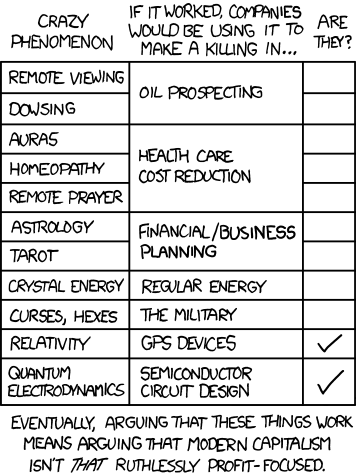
If astrology did arise in cities, it arose in a social environment where markets were familiar. Its entire history would have taken place amid money, contracts, and production for exchange. That calls into question the assumptions that we discussed last year when this xkcd appeared:

Not to be confused with "selling this stuff to OTHER people who think it works," which corporate accountants and actuaries have zero problems with.

Some people fall into the assumption that, because markets promote something called “rationality,” they must therefore favor every form of reason and disfavor every form of unreason. However, the rationality which comes from markets is in fact something of a very narrow sort. A month after our discussion, we noted that Shikha Dalmia had put it very well: “Markets don’t reward merit, they reward value.” Dalmia summarizes the views of economist Friedrich Hayek:

In a functioning market, Hayek insisted, financial compensation depends not on someone’s innate gifts or moral character. Nor even on the originality or technological brilliance of their products. Nor, for that matter, on the effort that goes into producing them. The sole and only issue is a product’s value to others. Compare an innovation as incredibly mundane as a new plastic lid for paint cans with a whiz-bang, new computer chip. The painter could become just as rich as the computer whiz so long as the savings from spills that the lid offers are as great as the productivity gains from the chip. It matters not a whit that the lid maker is a drunk, wife-beating, out-of-work painter who stumbled upon this idea through pure serendipity when he tripped over a can of paint. Or that the computer whiz is a morally stellar Ph.D. who spent years perfecting his chip.

As markets are neutral as to the virtue or vice of economic actors, so too are they neutral as to the truth or falsity of the ideas that those actors bring as products for sale. If falsehoods are in demand, falsehoods will sell; if truths are not in demand, their bearers will go begging. The mouseover text for the xkcd represents a nod to this fact, and an attempt to wriggle out of its implications: “Not to be confused with ‘selling this stuff to OTHER people who think it works,’ which corporate accountants and actuaries have zero problems with.” That won’t do, since it assumes that we can assign a fixed meaning to the expression “works.” An investment advisor who believes in astrology may not be any likelier than other advisors to beat the market, but s/he may very well use that belief to “make a killing,” if s/he attracts clients who strongly value such a belief. In that case, astrology would not “work” in the sense that quantitative analysts officially recognize, but it would make the advisor every bit as rich as it would if it did meet their definitions of success. As for whether it makes the clients rich, well, Fred Schwed answered that one in 1940:

Once in the dear dead days beyond recall, an out of town visitor was being shown the wonders of the New York financial district. When the party arrived at the Battery, one of his guides indicated some handsome ships riding at anchor. He said, “Look, these are the bankers’ and brokers’ yachts.” “Where are the customers’ yachts?,” asked the naive visitor.

Clearly, markets have not dissolved belief in astrology, any more than the continued non-existence of the customers’ yachts has discouraged people going to brokers and bankers. If the practice of judicial astrology first arose in cities, it may in fact be a by-product of market society. Perhaps we might find that judicial astrology began, not simply as a more elaborate version of a natural astrology that had long been a feature of rural life, but as an attempt to understand market interactions and the power of the market. In that case, it would qualify as a school of economics. One may wonder whether judicial astrology would be the most absurd such school in practice today.

The Atlantic, October 2011

Originally published on Los Thunderlads, 19 September 2011. Comment there.

The current issue of The Atlantic contains four pieces on which I took notes. All four of them had to do with masculinity in one way or another.

Historian Taylor Branch contributes an article about college sports in the USA. Non-USA types may not be aware that colleges and universities in the United States operate sports franchises, some of which have a mass following and an extremely lucrative financial aspect. The athletes are not paid for their participation in this multibillion dollar industry; they are not even compensated for injuries they receive in the course of them. Branch outlines the story of how this preposterously unfair system came to exist, and considers several recent developments that may bring it to an end. Athletes are symbols of masculinity in the USA, as elsewhere; the amateur ideal may once have been part of a concept of masculinity that some upper-class Americans cherished, but nowadays even volunteerism is often justified in terms of its resume-building potential. Moneymaking has become the masculine activity par excellence. So the National Collegiate Athletic Association’s (NCAA’s) model of the unpaid “student-athlete” is a bit of an anachronism.

A piece called “Sex and the Married Politician” includes several references to the fall of New York Congressman Anthony Weiner. Mr Weiner resigned his seat in the US House of Representatives shortly after it emerged that he had posted a picture of his genitalia on Twitter. It strikes me as misleading to call this story a “sex scandal.” Since everything on Twitter is public, Mr Weiner’s offense was not illicit sexual relations, but indecent exposure. As such, he is in a league with longtime Friendsville, Maryland mayor Spencer Schlosnagle, who in the mid-1990s pled guilty to charges stemming from several incidents when he exposed himself to passersby on the highway. Mr Schlosnagle paid a fine, went to a psychiatrist, and was reelected. He continues in office today. I think that the case of Mr Schlosnagle shows a community and a political system with a rational attitude towards mental illness. Mr Schlosnagle initially tried to deny the charges against him; when the prosecution made such denials impossible, he accepted punishment and sought counseling, thus reducing the likelihood that he will reoffend. Since his behavior was a real nuisance, the prosecution was rational. On the other hand, it was only a nuisance, not a serious threat to anyone in particular; therefore, the voters’ decision to reelect him once he had shown that he was addressing his mental health problems was also rational. Schlosnagle disclosed that he had suffered sexual abuse as a child, thus disowning any model of masculinity that would require him to project an image of himself as invulnerable or invincible. The description of Weiner as the main figure in a “sex scandal,” by contrast, both obscures the fact that he doesn’t seem to have had any sexual contact with anyone and presents him as a menacingly potent figure. I suppose it makes sense that he would have an easier time playing along with that image of himself that with presenting himself as a sick man compelled to behave in a somewhat annoying fashion.

The Library of America has finally devoted a volume to Ambrose Bierce, and this issue includes an admiring review of Bierce’s work and of the Library’s edition. I liked this sentence: “Bierce, after all, has always been best known for being undeservedly unknown.” Reviewer Benjamin Schwarz also makes some good points about Bierce’s lapidary style, such as this:

Bierce’s seminal contribution to American letters is that “sharp-edged and flexible style, like the ribbon of a wound-up steel tape-measure,” as Edmund Wilson perfectly defined it. But that style emerged from Bierce’s compulsion to reveal a truth that remains unacceptable—or only selectively acceptable—today. It’s all very nice to decry the horror of war, but to Bierce its obscenity and its meaninglessness were merely integral to those of life. Bierce’s friend the editor Bailey Millard explained why all the leading publishers of the day rejected Bierce’s war fiction: they “admitted the purity of his diction and the magic of his haunting power, but the stories were regarded as revolting.” Understandably so, given what Bierce knew to be our delusional and self-serving tendencies.

Schwarz approves of Bierce’s flatly declarative style, especially as regards the US Civil War in which Bierce fought with distinction. He quotes Walt Whitman’s remark that “The real war will never get into the books,” then says: “And in fact, excepting Bierce’s work, it didn’t.” That’s high praise indeed; Bierce, alone among the tens of thousands of authors who have published books on that conflict, succeeded in putting “the real war” into his books. I’ve posted previously about Bierce’s characteristic pose as The Man Without Illusions; evidently this is a pose Schwarz accepts at face value, and a form of masculinity he values highly.

B. R. Myers contributes a brief review essay on Australian crime fiction. He quotes this exchange from one such novel:

“I hear someone punched out that cunt Derry Callahan,” he said. “Stole a can of dog food too. You blokes investigatin that?”

Cashin frowned. “That right? No complaint that I know of. When it happens, we’ll pull out all the stops. Door-to-door. Manhunt.”

“Let’s see your hand.”

“Let’s see your dick.”

“C’mon. Hiding somethin?”

“Fuck off.”

Bern laughed, delighted, punched Cashin’s upper arm. “You fuckin violent bastard.”

Upon which Myers comments “I grinned right along with that, as if I hadn’t left high school hoping never to have to hear such exchanges again.” Indeed, talk like that is common among males of many ages and nationalities, and I can sympathize with Myers’ wish to escape from it. As with his admiration for that rather well-crafted specimen of it.

Friends Journal, September 2011

Originally published on Los Thunderlads, 17 September 2011. Comment there.

The September 2011 issue of Friends Journal includes a couple of brief pieces I wanted to note.

Geoffrey Kaiser writes of “Three Kinds of Singing in Meeting.” Kaiser tells of an old document he found when he was visiting Quaker meetings in New England in 1980. This document was an official statement that a monthly meeting* issued in 1675. It classified singing in meeting for worship** into three categories: “Serious Sighing,” “Sensible Groaning,” and “Reverent Singing.”

Erik Lehtinen, at the time of writing an Episcopalian deacon, explains in “True Confessions of a Closet Quaker” that he has for some time been sneaking out of his church to attend a Friends*** meeting, and that he has decided to leave the Episcopal church and to join the Quakers. Lehtinen writes that “Many seekers probably start by reading and being inspired by The Journal of George Fox.****” Seekers who are graduates of an Anglican seminary may start that way, but I very much doubt that Fox’s journals, written as they were in haste, in the seventeenth century, and by a man whose ideas are challenging to moderns in many ways, are in fact very attractive to a significant percentage of any other population. Still, it is useful to read Lehtinen’s description of Fox as “a fellow Anglican.” Fox spent his youth in the Church of England, and never quite admitted that he had left that communion.

*”Monthly meeting” is a Quakerese expression that other Christian traditions might translate as “parish” or “local church”

**”Meeting for worship” is also Quakerese; one might say, “worship service”

***”Friends” is Quakerese for “Quakers.” It’s a term that Quakers themselves find confusing, or claim to find confusing; they sometimes make a show of saying “friends- big ‘F’ and little ‘f,’” to highlight the fact that Friends can have friends who aren’t Friends.

****George Fox was the founder of Quakerism. There are people who think that lines like “Friends can have friends who aren’t Friends” are hilarious; such people have also been known to look for opportunities to make puns about foxes. So if you are thinking of joining with the Quakers, don’t say I didn’t warn you.